
How Much Cash Can You Keep When Filing Chapter 7?

How This Article Was Reviewed▾
How We Review This Educational Content▾
Why You Can Trust This Page▾
Cash in Chapter 7 - How Much Can You Keep?
It is possible to be able to keep cash when you file Chapter 7, but it depends on the bankruptcy exemptions you are able to use when you file.
To know if you can protect your cash when you file chapter 7:
- Know your exemption options: Find out what bankruptcy exemptions you are able to use when you file Chapter 7.
- Look for specific cash and/or wildcard exemptions within your state's exemption system, or if available, the federal exemption system: If available, a cash exemption, a wildcard exemption, or a combination of both could protect your cash.
Cash You Can Keep When Filing Chapter 7 Depends on Your Available Exemptions
If you want to figure out how much cash you can keep in Chapter 7 you have to determine which bankruptcy exemptions you are able to use and how much cash protection they offer you.
There are two steps to determine how much cash you can keep when you file Chapter 7. We discuss these steps, what bankruptcy exemptions are, how to determine which bankruptcy exemptions you can use, and everything else you need to understand this, below.
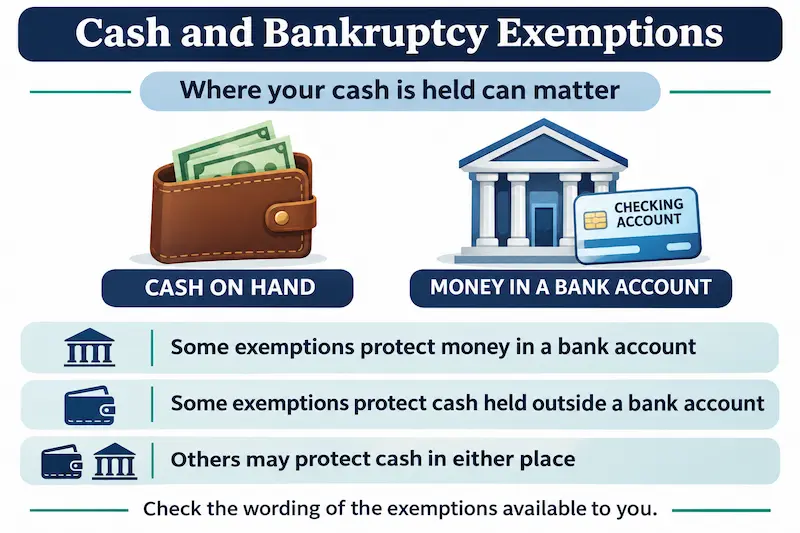
Cash can include both the physical cash you may have on hand, and cash that is in a checking or savings account. What you need to know is that some bankruptcy exemptions may only specifically cover cash if it's in a bank account, some exemptions may only cover cash if it isn't in a bank account, and some exemptions don't make any distinction. Please keep this in mind if you research your cash exemptions.
The source of cash is also an important consideration. Some funds, like Social Security benefits, can have separate protections. So when you're doing your research look for any other protections that could be available.
Two Steps To Determine How Much Cash You Can Keep When You File Chapter 7
There are generally two steps you will have to take to find out how much cash you can keep when you file Chapter 7. First, you must find out which exemptions you are able to use. The exemptions you use when you file depend on your specific situation. Next, after determining which exemptions you are able to use, you must determine the cash protection that the exemptions offer.
- Step 1: Find your exemption options
Figure out which bankruptcy exemptions you are able to use.
- Step 2: See how much cash they cover
Once you determine which exemptions you may use, compare your cash amount with the protection that is available.
Examples of How To Use This Process To See How Much Cash You Can Protect in Chapter 7
Below are examples of how to use our two-step process to determine how much cash you may be able to protect when you file Chapter 7.
Example 1. Bob Has $1,500 Cash He Wants to Protect in Arizona
Assume that Bob has lived permanently in Arizona the previous 3 years, and has $1,500.00 in a savings account he wants to protect when he files Chapter 7.
Step 1: Bob finds his exemption options. Since Bob has been domiciled in Arizona for 3 years, he is required to use Arizona bankruptcy exemptions.
Step 2: Bob looks at his available exemptions under his state's exemption laws. Since Arizona is an opt-out state, Bob looks at Arizona's exemptions and discovers that he can protect up to $5,600 in a single bank account, which is more than enough to protect Bob's $1,500 in cash. This is good news for Bob.
Example 2: Jane Wants to Protect $5,000 in Cash in New York
Assume Jane has lived in New York her entire life. She rents her home, has $5,000 in cash, and owns $10,000 in other personal property. She wants to know whether she can keep her cash when she files Chapter 7.
Step 1: Jane finds her exemption options. New York allows Jane to choose either New York bankruptcy exemptions or the federal bankruptcy exemptions. She must choose one system rather than combine exemptions from both. See New York Debtor and Creditor Law § 285.
Step 2: Jane compares how each system protects her cash. For this example, assume $8,675.00 of Jane's personal property is protected under New York's applicable personal property exemption (CPLR § 5205(a)), and $1,325 is protected by New York's Wild Card exemption. In this example Jane isn't claiming a homestead exemption, and no separate exemption applies to her cash.
Under New York exemptions: Jane subtracts her $10,000 in personal-property exemptions from the $13,625 shared limit. That leaves $3,625. Her conditional cash exemption is the smaller of that remaining amount or the $6,825 cash ceiling, so it protects $3,625 of her $5,000. The remaining $1,375 is not protected under these assumptions. She cannot add the state wildcard again because she already used it for her other property. See § 283 and the adjusted New York exemption amounts.
If Jane chose the federal exemptions: Because Jane does not use the federal homestead exemption, her available wildcard totals $17,475: the $1,675 base amount plus $15,800 in unused homestead protection. With no other claims against that allowance, it can cover her $10,000 in other property and all $5,000 in cash. These are the § 522(d)(5) amounts effective April 1, 2025.
The result: In this example, choosing federal exemptions allows Jane to protect all $5,000 in cash along with her other property. Finding her exemption options was only the first step. Applying each system to what she owns showed her which option provided more protection.
What are Bankruptcy Exemptions?
Bankruptcy Exemptions are laws that allow those who file bankruptcy to protect certain assets and avoid losing them to pay creditors. Some bankruptcy exemptions specifically protect cash and some bankruptcy exemptions protect cash and other assets.
Bankruptcy Exemptions are Usually Different in Each State
States make their own exemptions and they also determine which bankruptcy exemptions are available to their residents. There are federal bankruptcy exemptions, but the states determine whether or not their citizens may choose to use these exemptions or whether they may only use the state's exemptions. States that allow their citizens to use state exemptions and the federal exemptions are referred to as "dual choice" bankruptcy exemption states. States that do not let their citizens use the federal exemptions are referred to as "opt out" states.
If eligible, you can choose either the state exemption system or the federal bankruptcy exemptions. You choose one system, rather than mixing exemptions from both.
Generally, you must use the applicable state exemption system instead of the federal bankruptcy exemption list. Other federal protections may still be available.
How Do You Know Which Bankruptcy Exemptions You May Use?
You can use the bankruptcy exemption laws for the state you were domiciled in for 730 days "immediately preceding the date of the filing of the petition." In other words, you can use the exemptions for the state you were domiciled in for the 730 days (approximately 2 years) before the day you file for bankruptcy. See 11 U.S.C. § 522(b)(3)(A) for the exact wording of the statute.
What if you weren't domiciled in a state for 730 days before filing bankruptcy? If you weren't domiciled in one state for 730 days "immediately preceding the date of the filing of the bankruptcy petition," then you have to go back 180 days from the start of the 730 day period, and determine which state you were domiciled in the longest during that time, and this would be the state exemption laws you would usually be required to use. Here is a video below that helps explain this rule:
We understand that this rule can seem complicated, so we made a resource for you called the Bankruptcy Exemption Law Finder to help you determine which exemptions you can use. You can visit the tool's page or use it directly below.
Which Bankruptcy Exemptions Can I Use?
Where you live today does not always determine which bankruptcy exemptions you can use. Enter your domicile history to see which exemption law may apply.
This tool identifies the exemption system you may be eligible to use. It does not determine whether a particular house, vehicle, bank account, or other asset is fully protected.
This tool allows you to enter which states you were domiciled in and the dates that you lived there. Simply follow the prompts and you will receive a detailed overview of your domicile dates, and the state exemption laws that most likely apply to you. When you are finished you may print your results or save them for your records. We do not require any identifying or contact information to use this helpful tool.
Explore More National Bankruptcy Guides
Explore Bankruptcy Help by State
Browse our state guides to learn exemptions, means test rules, costs, and local procedures. Use these links to jump between states and compare your options.
- Arizona
- California
- Colorado
- Florida
- Georgia
- Illinois
- Indiana
- Maryland
- Michigan
- Nevada
- New York
- North Carolina
- Ohio
- Oregon
- Pennsylvania
- Tennessee
- Texas
- Virginia
- Wisconsin