
Bankruptcy in Nevada: Chapter 7, Chapter 13, Exemptions, and Where to File

How This Article Was Reviewed▾
How We Review This Educational Content▾
Why You Can Trust This Page▾
Bankruptcy in Nevada is mostly controlled by federal law, but Nevada-specific rules still matter. Nevada exemptions can affect what property you may be able to protect, Nevada median income figures are used in the chapter 7 means test, and your case must be filed in the correct Nevada bankruptcy court office.
Most individuals in Nevada consider chapter 7 or chapter 13 bankruptcy. Chapter 7 may help if your main goal is a faster discharge of qualifying unsecured debt, such as credit cards, medical bills, personal loans, or collection accounts. Chapter 13 may help if you need time to catch up on a mortgage, car loan, taxes, support arrears, or other debts through a repayment plan.
This Nevada bankruptcy guide is designed to help you choose the right next step. It explains the major Nevada bankruptcy issues, including chapter choice, exemptions, income limits, court filing location, the automatic stay, property protection, and common mistakes to avoid before filing.
Bankruptcy in Nevada: Start With the Problem You Need to Solve
The right bankruptcy option in Nevada really depends on what is going wrong in your life right now. Someone buried in credit cards or medical bills may need a different approach than someone trying to stop a wage garnishment, halt a foreclosure, hang on to a car, or protect property with equity.

Instead of starting with chapter 7 versus chapter 13, begin by naming the problem that feels most urgent today.
Start by asking what bankruptcy needs to fix for you:
- Are credit cards, medical bills, or personal loans the biggest headache?
- Has a creditor, collector, or debt buyer filed a lawsuit against you?
- Are your wages already being garnished or about to be?
- Are you behind on your mortgage payments?
- Has your lender threatened or scheduled a foreclosure sale?
- Are you behind on a car loan?
- Is your vehicle in danger of being repossessed?
- Do you owe recent taxes or other debts that may need special treatment?
- Do you own a home, vehicle, business, or other property with equity?
- Are you unsure whether Nevada exemptions are enough to protect what you own?
- Have you recently transferred property or repaid friends or family?
- Are you unsure whether chapter 7 or chapter 13 would serve you better?
Your answers help point you toward the next move. If unsecured debt is your main problem and it looks like Nevada exemptions cover your property, chapter 7 might be a good option to explore. If you are behind on a house or car, facing foreclosure or repossession, dealing with tax or support arrears, or worried that some property may not be fully protected, chapter 13 may be worth a closer look.
Deadlines also matter. If you are staring down a foreclosure sale, repossession, lawsuit, or wage garnishment, the calendar can be just as important as the law. Bankruptcy can offer strong protection, but waiting too long can limit the help it can provide.
Bankruptcy in Nevada at a Glance
If you live in Nevada and are thinking about bankruptcy, you’re working with a mix of federal rules and Nevada-specific protections. State exemptions, Nevada median income numbers, where your case is filed, local court procedures, and which chapter you choose can all shape your results.
- Most common consumer options: Most individuals in Nevada look at either Chapter 7 or Chapter 13 bankruptcy, depending on their income, assets, and goals.
- Chapter 7: Often used for a quicker fresh start on qualifying unsecured debts such as credit cards, medical bills, personal loans, and many collection accounts, if you are eligible.
- Chapter 13: May be helpful if you need structured time to catch up on a mortgage, car loan, certain taxes, support arrears, or other debts through a court-approved repayment plan.
- Nevada exemptions: Nevada’s exemption laws help decide what property you can keep, including some home equity, vehicle equity, funds in bank accounts, portions of tax refunds, wages, benefits, and other assets.
- Means test: Nevada median income figures are part of the Chapter 7 means test, which helps determine whether Chapter 7 is an option for you or whether Chapter 13 deserves a closer look.
- Automatic stay: When you file, an automatic stay usually goes into effect and can pause many collection actions, including lawsuits, wage garnishments, foreclosure steps, repossessions, and many collection calls.
- Required courses: Most consumer filers must complete a credit counseling course before filing and a debtor education course after filing in order to receive a discharge.
- Where cases are filed: Nevada bankruptcy cases are filed in the United States Bankruptcy Court for the District of Nevada, which has court locations in Las Vegas and Reno.
- The key question: The right approach depends on what you need bankruptcy to fix, what property you need to protect, and whether Chapter 7 or Chapter 13 gives you a more realistic path forward.
Chapter 7 vs. Chapter 13 Bankruptcy in Nevada
Many people in Nevada who file for bankruptcy end up in either Chapter 7 or Chapter 13 bankruptcy. The better fit for you depends on your income, the kinds of debts you have, the property you want to protect, and what you hope bankruptcy will actually fix.
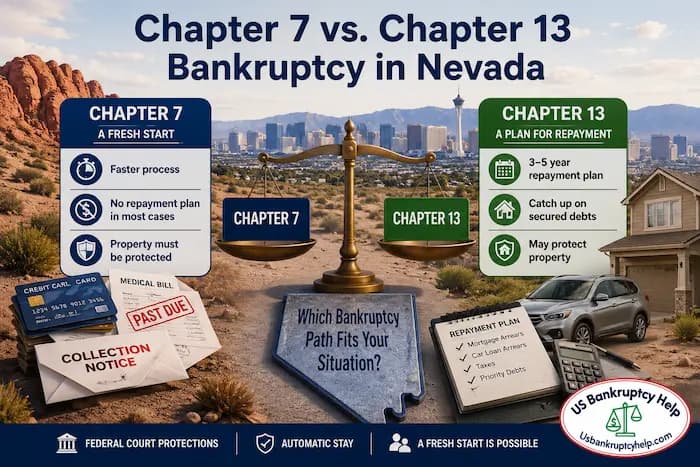
Chapter 7 is often used when the main goal is to wipe out qualifying unsecured debts, such as credit cards, medical bills, personal loans, and collection accounts. Chapter 13 is often used when you need time and structure to deal with a mortgage or car loan, stop foreclosure, prevent repossession, protect property, or handle debts that need special treatment.
| Issue | Chapter 7 in Nevada | Chapter 13 in Nevada |
|---|---|---|
| Main purpose | Focuses on getting a quicker discharge of qualifying unsecured debts. | Uses a court-approved repayment plan to catch up, protect property, or manage debts over time. |
| Typical timeline | In a straightforward case, the process often lasts only several months. | Usually runs three to five years because you make plan payments over an extended period. |
| Income issue | The Chapter 7 means test uses Nevada median income figures and other income and expense rules to see if you qualify. | You need regular income that can realistically support the monthly plan payments. |
| Property issue | Nevada exemptions help show which property appears protected. Nonexempt property can create risk in Chapter 7. | You may be able to keep more property, but any nonexempt value can affect how much must be paid through the plan. |
| Mortgage arrears | Filing may temporarily stop foreclosure, but Chapter 7 usually does not offer a long-term way to catch up on missed mortgage payments. | Missed mortgage payments can often be spread out and paid through the plan while you continue making your regular payments. |
| Car loan arrears | Filing may temporarily stop repossession, but it usually does not provide a lasting catch-up structure. | Missed car payments may be handled through the plan, and timely filing can help stop repossession. |
| Best fit | Often worth exploring if unsecured debt is your main problem, you fit the Chapter 7 rules, and your property appears protected by Nevada exemptions. | Often worth exploring if you need more time, structure, or court-backed protection than Chapter 7 can offer. |
The real issue is not which chapter is better in theory. The real question is which chapter lines up with the problem you actually have. If most of your stress comes from unsecured debts and your property looks protected, Chapter 7 may be a good starting point. If you are behind on a house or car, facing foreclosure or repossession, dealing with priority debts, or trying to shield property that may not be fully exempt, Chapter 13 may deserve a careful look.
Need the full Nevada chapter-specific guide?
- Review our Nevada Chapter 7 bankruptcy guide if your main concerns are credit cards, medical bills, personal loans, collections, lawsuits, or Chapter 7 income eligibility.
- Review our Nevada Chapter 13 bankruptcy guide if you are behind on a mortgage or car loan, facing foreclosure or repossession, dealing with priority debts, or need a structured repayment plan.
Use the Nevada Chapter 7 vs. Chapter 13 Decision Tool
The decision tool below helps people in Nevada compare Chapter 7 and Chapter 13 based on the real‑world money issues that usually drive the choice. When Nevada is selected, the tool uses Nevada‑specific information, including Nevada median income data and Nevada exemption rules, to help screen whether Chapter 7 or Chapter 13 may deserve a closer look.
This matters because chapter choice is almost never about a single question. Household size, income, secured‑debt problems, home equity, vehicle equity, bank accounts, tax refunds, foreclosure and repossession risks, and your main reason for filing can all influence whether Chapter 7 or Chapter 13 is more likely to fit your situation.
Chapter 7 vs Chapter 13 Decision Tool
Answer a few questions to get an educational estimate of which bankruptcy chapter may fit your situation.
Step 1 of 2
Window 1 of 2: Income Snapshot
ZIP lookup is optional and used as a quick state check.
For example, Chapter 7 may be a better fit if your main problem is unsecured debt and the Nevada means test, property, and exemption issues appear manageable. Chapter 13 may deserve closer review if you need time to catch up on mortgage arrears, stop foreclosure, deal with vehicle arrears, prevent repossession, manage certain taxes or support obligations, or protect property that might not be fully covered in a Chapter 7 case.
The tool is not legal advice and it cannot guarantee the "right" chapter for your case. It can, however, help you organize the Nevada‑specific income, exemption, property‑risk, and debt‑pressure issues that should be reviewed before deciding whether Chapter 7 or Chapter 13 is likely to be the better fit.
Bankruptcy Chapter 7 Nevada: When Chapter 7 May Help
If you are considering chapter 7 bankruptcy in Nevada, you usually have to figure out three main questions first: whether you qualify under the means test, whether Nevada exemptions protect your property, and whether chapter 7 will address the debts causing the problem.
In Nevada, Chapter 7 is most often used when unsecured debt is the main problem. That can mean credit cards, medical bills, personal loans, collection accounts, old utility bills, or a balance that’s left over after a repossession or voluntary surrender.
Chapter 7 may be worth a closer look in Nevada if:
- Credit cards, medical bills, or personal loans are your main source of stress.
- You are being sued or have been warned about a possible wage garnishment.
- Your income seems to fit within the Chapter 7 means test rules.
- Your home, vehicle, bank accounts, and other key property appear to be covered by Nevada exemptions.
- You do not need a long-term repayment plan to catch up on a mortgage or car loan.
- You have not recently given away valuable property or repaid family members in a way that could raise concerns in a bankruptcy case.
Chapter 7 also has real limits. It may pause foreclosure or repossession through the automatic stay, but it usually does not give you a long-term way to cure missed mortgage payments or car payments. If you are behind on a house or car and want to keep it, Chapter 13 may need to be part of the conversation.
Nevada exemptions are another key piece. Even if most of your debt can be discharged, you still want to know whether your home equity, vehicle equity, bank balances, tax refunds, possible lawsuit claims, and other property are protected before you move ahead with a Chapter 7 filing.
For a deeper Nevada-specific overview, including income eligibility, the means test, exemption questions, property risks, and common Chapter 7 mistakes, have a look at our Nevada Chapter 7 bankruptcy guide.
Chapter 7 Bankruptcy Income Limits in Nevada
When people look up Chapter 7 bankruptcy income limits in Nevada, they are usually asking about the Nevada median income figures used in the first step of the Chapter 7 means test. These are not lifetime caps. They change from time to time and depend on your household size and the date you file.
The means test compares your recent household income to the Nevada median income for a household of your size. If your income is below the applicable Nevada median, Chapter 7 is often easier to consider. If your income is above median, that does not automatically mean you are ineligible. The analysis usually continues by looking at allowed deductions and your remaining disposable income.
For Nevada filers, Chapter 7 income eligibility can depend on:
- Your household size
- Your gross income during the six full calendar months before filing
- The current Nevada median income figures on your filing date
- Changes in income, such as job loss, overtime, bonuses, or commissions
- Business income, self-employment income, or other irregular income
- Which deductions are allowed if your income is above the Nevada median
- Whether your debts are mainly consumer debts or business debts
Because this is only the Nevada home page, the full income-limit table and calculator live on the dedicated Chapter 7 page. For current Nevada median income figures, a state-specific means test explanation, and the Nevada Chapter 7 calculator, see our Nevada Chapter 7 bankruptcy guide.
Chapter 13 Bankruptcy in Nevada: When a Repayment Plan May Help
Chapter 13 bankruptcy in Nevada is built around a court-approved repayment plan. Instead of aiming for a faster discharge like in Chapter 7, you propose a plan that usually runs three to five years, and you make regular payments through the Chapter 13 trustee during that time.
Chapter 13 is often worth a look when you need time, structure, or protection that Chapter 7 cannot provide. Nevada filers commonly use it when they are behind on a mortgage or car loan, facing foreclosure, trying to stop repossession, dealing with tax debt, or trying to keep property that might not be fully protected in Chapter 7.
Chapter 13 may be worth reviewing in Nevada if:
- You are behind on your mortgage and want to keep your home.
- A foreclosure sale has been threatened or a sale date has been set.
- You are behind on a car loan and want to stop repossession.
- You need a structured way to catch up on missed payments on secured debts.
- You owe recent taxes that may not be wiped out in Chapter 7.
- You owe domestic support arrears that need to be paid through a plan.
- Your income creates a chapter 7 means-test issue, or its irregular nature makes eligibility and timing more difficult to evaluate.
- You own property that may not be fully covered by Nevada exemptions.
- You need a payment structure that fits your budget better than lawsuits, garnishments, or one-off payment demands.
A Nevada Chapter 13 plan has to be realistic. The payment amount can be influenced by your income, necessary living expenses, mortgage and vehicle arrears, tax debts, support arrears, attorney fees, trustee fees, and the value of any nonexempt property that must be accounted for in the plan.
Chapter 13 can be a strong tool when you need to stop urgent collection pressure and protect important property, but it only works if the monthly payment fits your actual budget. If the payment is set too high to maintain, the case may not succeed.
For a full Nevada-specific overview, including how Chapter 13 plans are structured, how mortgage and vehicle arrears may be handled, and how Nevada exemptions can affect plan payments, see our Nevada Chapter 13 bankruptcy guide.
Nevada Bankruptcy Exemptions: Why They Matter Before You File
Nevada bankruptcy exemptions help answer a simple but important question: what can you keep if you file in Nevada? These rules can affect home and vehicle equity, money in bank accounts, tax refunds, wages, benefits, tools, household goods, lawsuits, injury claims, inheritances, and other assets.
Exemptions matter in both Chapter 7 and Chapter 13. In Chapter 7, Nevada exemptions help determine whether a trustee may look at nonexempt property for the benefit of creditors. In Chapter 13, you usually keep your property, but any nonexempt value can influence how much unsecured creditors must receive through the repayment plan.
The analysis is more than just matching property to a list of dollar amounts. You need to know what you own, what it is worth, how much you owe against it, whether Nevada exemptions protect the equity or value, and whether Chapter 7 or Chapter 13 is the safer path.
Before relying on Nevada exemptions, ask:
- Do you own a home or have equity in real estate?
- Do you own a car, truck, motorcycle, or other vehicle?
- How much money is likely to be in your bank accounts on the filing date?
- Are you expecting a federal or state tax refund?
- Do you own tools, business property, or other valuable personal items?
- Do you receive Social Security, disability, retirement, or other benefits?
- Do you have a lawsuit, injury claim, inheritance, or settlement pending or possible?
- Have you recently moved to Nevada from another state?
- Would any nonexempt property make Chapter 13 safer than Chapter 7?
Recent movers should be especially cautious. The exemption rules that apply can depend on how long you have lived in Nevada before filing. If you moved from another state, there may be a separate domicile analysis before you can safely rely on Nevada exemption amounts.
For a detailed Nevada-specific breakdown, including homestead and vehicle protections, personal property exemptions, benefits, wages, wildcard rules, and examples, see our Nevada bankruptcy exemptions guide.
The core idea is straightforward: bankruptcy does not automatically shield everything you own. Before filing, take stock of your property, estimate the equity or value, compare it with Nevada exemptions, and decide whether Chapter 7 appears safe or whether Chapter 13 offers a better way to protect property while addressing your debt.
Keeping Your House in Nevada Bankruptcy
Many Nevada homeowners thinking about bankruptcy want to know whether they can keep their house. The answer usually comes down to four things: which chapter you file, how much equity you have, whether you are current or behind on the mortgage, and whether Nevada exemptions are strong enough to protect your equity.
Bankruptcy does not automatically erase a mortgage lien if you plan to keep the home. You usually have to tackle two separate questions: protecting your equity and either staying current on the mortgage or using Chapter 13 to catch up on missed payments.
For Nevada homeowners, the main questions are:
- What is the home realistically worth in today’s market?
- How much is still owed on the mortgage payoff?
- Are there other liens, judgments, or claims against the property?
- How much equity needs exemption protection?
- Does the Nevada homestead exemption appear to cover that equity?
- Are you current on mortgage payments, or are you behind?
- Has foreclosure been threatened or has a sale date been set?
- Does Chapter 7 or Chapter 13 better match the problem you are trying to solve?
In Chapter 7, Nevada exemptions help show whether your home equity appears protected. If the equity is not fully covered, Chapter 7 may create property risk. Chapter 7 can pause foreclosure for a time through the automatic stay, but it usually does not give you a long-term way to make up missed mortgage payments.
In Chapter 13, you may be able to keep the home while catching up on mortgage arrears through a repayment plan. You typically must keep making regular mortgage payments after filing, and the Chapter 13 plan has to be realistic in light of your income, expenses, arrears, and other debts.
For a detailed Nevada homestead overview, including current exemption amounts, equity examples, and how the homestead interacts with Chapter 7 and Chapter 13, see our Nevada bankruptcy exemptions guide.
Keeping Your Car in Nevada Bankruptcy
Many Nevada filers need to keep a car, truck, or other vehicle to get to work, manage family responsibilities, reach medical care, and handle daily life. Whether bankruptcy can help you keep a vehicle depends on which chapter you file, whether you are current or behind on the loan, how much equity you have, and whether Nevada exemptions are strong enough to protect that equity.
A car loan and vehicle equity are related but different issues. If you want to keep a financed vehicle, you usually need to protect the equity and either stay current on the loan or use Chapter 13 to deal with missed payments.
For Nevada vehicle owners, the main questions are:
- What is the vehicle realistically worth today?
- How much is still owed on the loan payoff?
- Is the vehicle paid off or still financed?
- How much equity needs exemption protection?
- Does the Nevada vehicle exemption appear to cover that equity?
- Are you current on payments, or are you behind?
- Has repossession been threatened, scheduled, or already happened?
- Does Chapter 7 or Chapter 13 better match the problem you are trying to solve?
In Chapter 7, Nevada exemptions help show whether your vehicle equity appears protected. If the car is paid off or has more equity than the exemption covers, Chapter 7 can create property risk. Chapter 7 can also pause repossession for a short time through the automatic stay, but it usually does not provide a long-term way to catch up on missed car payments.
In Chapter 13, you may be able to keep the vehicle while handling missed payments through a repayment plan. Chapter 13 can also change how some car loans are treated, depending on the vehicle’s value, the loan balance, when you bought the vehicle, the interest rate, and whether the plan meets bankruptcy requirements.
For a full Nevada vehicle exemption discussion — including current exemption amounts, examples of how vehicle equity works in practice, and how car loans may be handled in Chapter 7 and Chapter 13 — see our Nevada bankruptcy exemptions guide.
What Bankruptcy Can Stop in Nevada
One of the most immediate benefits of filing bankruptcy is the automatic stay. In most cases, the automatic stay goes into effect as soon as your case is filed and temporarily stops many collection actions while your case moves through the system.

For Nevada filers, the automatic stay can create breathing room to look at options without constant collection pressure. It does not stop every type of legal action, though, and its protection can be limited if you have filed other bankruptcy cases recently.
| Collection Activity | May Be Stopped by Bankruptcy? | Important Notes |
|---|---|---|
| Collection calls and letters | Usually yes | Most collection efforts must stop once the automatic stay is in place. |
| Creditor lawsuits | Usually yes | Many pending lawsuits are paused while the bankruptcy case is active. |
| Wage garnishment | Usually yes | Many wage garnishments stop after filing, although there are exceptions. |
| Bank levies | Often yes | Timing matters. Filing may stop an incomplete levy, but recovering funds already transferred to a creditor can require a separate legal analysis and may not always be possible. |
| Foreclosure | Usually temporarily | Bankruptcy often pauses foreclosure, but Chapter 13 is usually the chapter used to catch up on missed mortgage payments. |
| Vehicle repossession | Usually temporarily | Bankruptcy may stop repossession, but Chapter 13 often provides a better longer-term solution if you are behind on payments. |
| Utility shutoff | Limited protection | Bankruptcy may offer short-term protection, but you generally must meet extra requirements to keep service going. |
The automatic stay has important limits.
- Bankruptcy does not automatically wipe out a mortgage or vehicle loan if you want to keep the property.
- Some family law matters, including many domestic support obligations, can continue despite the bankruptcy filing.
- Certain tax proceedings and criminal matters are not stopped by the automatic stay.
- Creditors can ask the bankruptcy court for permission to continue certain actions in appropriate situations.
- If you have filed one or more bankruptcy cases recently, the automatic stay may be shortened or may not take effect automatically.
Timing can make a real difference. If your wages are being garnished, your home is in foreclosure, your vehicle is at risk of repossession, or a lawsuit is moving forward, waiting too long may limit how much protection bankruptcy can offer.
The automatic stay is one of bankruptcy’s most powerful tools, but it is only one part of the overall picture. The right chapter still depends on your income, property, debts, payment problems, and the specific relief you need.
How to File Bankruptcy in Nevada
Filing bankruptcy in Nevada is handled through the federal bankruptcy court. The path you follow will depend on whether you file Chapter 7 or Chapter 13, what property you own, whether you are behind on secured debts, and whether there are urgent issues such as foreclosure, repossession, wage garnishment, or recent asset transfers.
The outline below is only a general overview. Bankruptcy involves strict rules, detailed filing requirements, full financial disclosure, deadlines, and local procedures. Most people should at least talk with a qualified Nevada bankruptcy attorney before deciding to file.
| Step | What It Means | Why It Matters |
|---|---|---|
| 1. Choose the right chapter | Decide whether Chapter 7 or Chapter 13 is the better fit for your situation. | Chapter 7 may help with qualifying unsecured debt, while Chapter 13 may help with mortgage arrears, car arrears, tax issues, support arrears, or nonexempt property. |
| 2. Review Nevada exemptions | Compare what you own and the equity you have with the exemptions that may apply in Nevada. | Exemptions can affect homes, vehicles, bank accounts, wages, benefits, tools, lawsuits, tax refunds, and other property. |
| 3. Complete credit counseling | Take the required pre-filing credit counseling course from an approved provider. | In most cases, this course must be finished before the bankruptcy petition is filed. |
| 4. Gather documents | Collect income records, recent tax returns, bank statements, bills, lawsuits, loan statements, vehicle information, mortgage information, and property value estimates. | Your schedules must accurately list income, expenses, debts, assets, transfers, lawsuits, and other financial details. |
| 5. File in the correct Nevada office | File the petition, schedules, statements, and required forms with the United States Bankruptcy Court for the District of Nevada. | The proper filing location depends on Nevada court procedures and where your case belongs within the district. |
| 6. Attend the 341 meeting | Appear at the meeting of creditors (also called the 341 meeting) with the assigned trustee. | The trustee confirms your identity and asks questions about your petition, schedules, property, income, debts, and recent financial activity. |
| 7. Complete debtor education | Take the required post-filing debtor education course from an approved provider. | This second course is usually required before a discharge can be entered. |
| 8. Receive discharge or complete the plan | In Chapter 7, eligible debts may be discharged after the case requirements are met. In Chapter 13, a discharge usually comes after you complete the repayment plan. | The final result depends on the chapter you filed, which debts are at issue, whether anyone objects, and whether you complete all required steps. |
Before filing bankruptcy in Nevada, make sure you understand:
- Which chapter is more likely to solve the real problem you are facing.
- Whether your property appears to be protected by available exemptions.
- Whether your income creates a means-test issue or a plan-payment issue.
- How foreclosure, repossession, garnishment, or lawsuits affect timing.
- Whether any recent transfers or repayments could cause complications.
- Whether all required courses, forms, and supporting documents are ready.
Filing the case is only one piece of the puzzle. The bigger question is whether bankruptcy is being used in the right way. Someone dealing mostly with credit card debt may need a very different approach than someone trying to stop foreclosure, save a vehicle, address tax debt, or protect nonexempt property.
United States Bankruptcy Court Nevada: Where to File
Nevada has one bankruptcy court district: the United States Bankruptcy Court for the District of Nevada. Within this district there are two filing offices, located in Las Vegas and Reno. These offices handle Nevada bankruptcy cases.
The District of Nevada is divided into two bankruptcy divisions. The Southern Division is administered through the Las Vegas office, and the Northern Division is administered through the Reno office. The correct place to file depends on the county where the debtor (filer) lives.
| Nevada Bankruptcy Court Office | Address | Division | Counties Assigned to Office |
|---|---|---|---|
| Las Vegas Office | U.S. Bankruptcy Court, District of Nevada Foley Federal Building 300 Las Vegas Boulevard South Las Vegas, NV 89101 Phone: (702) 527-7000 | Southern Division | Clark, Esmeralda, Lincoln, and Nye Counties |
| Reno Office | U.S. Bankruptcy Court District of Nevada C. Clifton Young Federal Building and U.S. Courthouse 300 Booth Street Reno, NV 89509 Phone: (775) 326-2100 | Northern Division | Carson City, Churchill, Douglas, Elko, Eureka, Humboldt, Lander, Lyon, Mineral, Pershing, Storey, Washoe, and White Pine Counties |
Nevada Bankruptcy Court Self-Help and Pro Se Resources
The Nevada Bankruptcy Court offers information for people who file without an attorney, often called pro se filers. These materials can help you understand filing requirements, fees, forms, basic bankruptcy procedure, court terminology, and what may happen after a case is filed.
These resources are educational only. The clerk’s office cannot give legal advice, cannot tell you whether to file bankruptcy, cannot choose Chapter 7 or Chapter 13 for you, cannot tell you which exemptions to claim, and cannot act as your attorney.
| Resource | What It May Help With | Important Limit |
|---|---|---|
| Nevada Bankruptcy Court Pro Se Information | Filing requirements, filing fees, Chapter 7 and Chapter 13 information, court forms, bankruptcy terminology, and general court procedure. | Court staff can explain procedures, but they cannot give legal advice. |
| Legal Aid Center of Southern Nevada | Bankruptcy education, public classes, manuals, videos, and legal information for people considering filing without an attorney. | These tools are educational and do not replace advice from a qualified bankruptcy attorney. |
| Northern Nevada Legal Aid | Legal aid resources for qualifying low-income residents in Northern Nevada, including bankruptcy-related help where available. | Eligibility, availability, and the type of assistance offered can depend on the person, location, and case. |
Self-help resources may help you understand:
- Which bankruptcy forms may be required.
- What filing fees or fee-waiver options may apply.
- Where to file based on your Nevada county.
- What typically happens at a 341 meeting of creditors.
- How to access court forms and basic filing instructions.
- Where to look for free or low-cost legal assistance.
Self-help resources generally cannot answer questions like:
- Should I file bankruptcy at all?
- Should I file Chapter 7 or Chapter 13?
- Which Nevada exemptions should I claim?
- Will I lose my home, car, tax refund, lawsuit, or bank account funds?
- Will a particular debt be discharged?
- How should I respond to a trustee, creditor, objection, or motion?
Before filing with the Nevada bankruptcy court, check:
- Which county determines where your case must be filed.
- Whether you are proceeding under Chapter 7 or Chapter 13.
- Whether Nevada exemptions appear to protect your key property.
- Whether foreclosure, repossession, garnishment, or lawsuits affect timing.
- Whether you completed the required pre-filing credit counseling course.
- Whether all schedules, statements, and required forms are complete.
You can review office information directly on the United States Bankruptcy Court for the District of Nevada website. You can also review the court’s where-to-file guidance, filing-without-an-attorney resources, and legal-services page.
Filing-Readiness Checklist for Nevada Bankruptcy Cases
Before you file bankruptcy in Nevada, it helps to slow down and look at the issues that most often affect chapter choice, property protection, timing, and overall case risk. A bankruptcy petition is more than a list of debts. It also requires careful disclosure of income, assets, expenses, transfers, lawsuits, secured debts, priority debts, and other financial details.
This checklist is not legal advice, but it can help you spot topics that should be reviewed before a Nevada bankruptcy case is filed.
Before filing bankruptcy in Nevada, review:
- Chapter choice: Are you mainly trying to wipe out unsecured debt, stop foreclosure, catch up on a car loan, protect property, deal with tax debt, or solve some other problem?
- Chapter 7 means test: Does your household income appear below or above the Nevada median income for your household size, and how do allowable expenses affect that result?
- Nevada exemptions: Have you checked whether the applicable exemptions protect your home, vehicle, bank accounts, wages, benefits, tools, personal property, refunds, and other assets?
- Home equity: What is your home realistically worth, what is the mortgage payoff, are there other liens, and how much equity needs protection?
- Car equity: What is each vehicle worth, what is owed on it, and does the Nevada vehicle exemption appear to protect the equity?
- Bank accounts: How much money is likely to be in checking, savings, prepaid cards, payment apps, and other accounts on the filing date?
- Tax refunds: Are you expecting a federal or state tax refund, and could any part of that refund become property of the bankruptcy estate?
- Lawsuits and claims: Do you have a personal injury claim, employment claim, insurance claim, inheritance issue, contract claim, or any other right to receive money?
- Recent transfers: Have you sold, gifted, transferred, or retitled property before filing, including vehicles, real estate, business interests, bank funds, or valuable personal items?
- Family repayments: Have you repaid money to relatives, friends, business partners, insiders, or favored creditors shortly before filing?
- Secured debts: Are you current or behind on mortgages, car loans, title loans, furniture loans, jewelry loans, or other debts tied to collateral?
- Priority debts: Do you owe recent taxes, domestic support, restitution, or other debts that may receive special treatment in bankruptcy?
- Collection timing: Is there an active wage garnishment, bank levy, lawsuit, foreclosure, repossession, eviction, or utility shutoff that could affect when the case should be filed?
- Required courses: Have you completed the approved pre-filing credit counseling course, and do you understand the post-filing debtor education requirement?
- Court office: Does your county file through the Las Vegas office or the Reno office of the United States Bankruptcy Court for the District of Nevada?
A straightforward credit card case may look very different from a case that involves home equity, car arrears, tax debt, lawsuits, business assets, recent transfers, or payments to family members. Those issues can affect whether Chapter 7 appears safe, whether Chapter 13 is necessary, and whether filing now or waiting makes more sense.
If several items on this checklist apply to you, the next step is not simply to submit forms. A safer approach is to review your facts carefully, compare Chapter 7 and Chapter 13, confirm which exemptions apply, and decide whether a qualified Nevada bankruptcy attorney should review the case before anything is filed.
Common Nevada Bankruptcy Mistakes
Bankruptcy can be very helpful when it is used carefully, but missteps before filing can add avoidable risk. In Nevada cases, trouble often comes from filing too late, picking the wrong chapter, guessing at values, or assuming a case is simpler than it really is.
| Mistake | Why It Can Matter |
|---|---|
| Waiting too long to file | Waiting until after a foreclosure sale, repossession, wage garnishment, bank levy, or judgment collection can shrink what bankruptcy is able to fix. |
| Choosing the wrong chapter | Chapter 7 and Chapter 13 solve different problems. Someone trying to catch up on mortgage arrears, protect nonexempt property, or manage secured debt may need a very different approach than someone whose main issue is credit cards or medical bills. |
| Assuming Nevada exemptions protect everything | Exemptions protect certain kinds of property up to specific limits. They should be reviewed closely before filing, especially if you own a home, vehicle, tools, valuable personal items, bank funds, refunds, or legal claims. |
| Guessing at property values | Home values, vehicle values, business assets, jewelry, collectibles, lawsuits, and other property should not be guessed at. Inaccurate values can affect exemptions, trustee review, and which chapter makes sense. |
| Forgetting bank accounts or tax refunds | Money in checking and savings accounts, payment apps, prepaid cards, and expected tax refunds often needs to be disclosed and reviewed for exemption coverage. |
| Leaving out lawsuits or legal claims | Personal injury claims, employment claims, insurance claims, inheritance rights, contract claims, and other rights to receive money may count as assets even if you have not been paid yet. |
| Transferring property before filing | Selling, gifting, retitling, or moving property before bankruptcy can cause serious problems, especially if it looks like an effort to shield assets from creditors or if the transfer was not for fair value. |
| Repaying family or favored creditors | Paying relatives, friends, business partners, insiders, or favored creditors shortly before filing may be reviewed by a trustee and can create avoidable complications. |
| Ignoring the Chapter 7 means test | Nevada household income, household size, allowable expenses, and timing can affect Chapter 7 eligibility. Being over the median income does not always rule out Chapter 7, but it does mean the analysis needs more care. |
| Ignoring prior bankruptcy filings | Prior cases can affect discharge eligibility and automatic stay protection. A recent filing may limit or block the automatic stay unless the court approves additional relief. |
Most of these problems can be avoided. Before filing, take stock of your assets, debts, income, exemptions, recent transactions, lawsuits, prior filings, and key collection deadlines. If your situation involves home equity, car arrears, tax debt, lawsuits, recent transfers, family repayments, or prior bankruptcies, getting advice first is especially important.
What Happens After Filing Bankruptcy in Nevada?
Once a bankruptcy case is filed in Nevada, it moves through the federal bankruptcy court system. The timeline and next steps will depend on whether you filed under Chapter 7 or Chapter 13, whether your paperwork is complete, whether the trustee or any creditors raise concerns, and whether you finish all required tasks.
| Step After Filing | What Usually Happens | Why It Matters |
|---|---|---|
| Automatic stay begins | Filing typically triggers the automatic stay, which can stop many collection calls, lawsuits, wage garnishments, bank levies, foreclosures, and repossessions. | The stay can provide immediate breathing room, but it has limits — especially if you have had other bankruptcy cases in the recent past. |
| Trustee is assigned | A bankruptcy trustee is appointed to review your petition, schedules, statements, income, property, exemptions, debts, and financial history. | The trustee plays a key role in checking your documents, asking about assets and transfers, and making sure the case appears complete and accurate. |
| Document requests are issued | The trustee may request tax returns, pay stubs, bank statements, mortgage statements, vehicle documents, proof of insurance, value estimates, and other records. | Missing or incomplete documents can slow the case down, raise questions, or lead to additional follow-up from the trustee. |
| 341 meeting of creditors is held | You attend a meeting with the trustee and answer questions under oath about your bankruptcy papers, property, debts, income, expenses, transfers, and financial history. | Creditors can attend, but in many consumer cases the trustee’s questions are the main focus of the meeting. |
| Debtor education course is completed | After filing, you must complete the required debtor education course from an approved provider. | This second course is usually required before the court can enter a discharge. |
| Chapter 7 discharge path | In a typical Chapter 7 case, eligible debts may be discharged after trustee review, the 341 meeting, completion of the course, and the passing of any objection deadlines. | Chapter 7 is usually quicker than Chapter 13, but property, exemption, income, and discharge issues still need to be handled correctly. |
| Chapter 13 plan process | In Chapter 13, you propose a repayment plan, begin making plan payments, attend the 341 meeting, and work toward plan confirmation and completion. | Chapter 13 can address mortgage arrears, car arrears, certain tax debts, support issues, and nonexempt property, but the plan must be realistic and must meet bankruptcy requirements. |
After filing, Nevada debtors should be ready to:
- Respond quickly and completely to trustee document requests.
- Attend the 341 meeting and answer the trustee’s questions truthfully.
- Finish the debtor education course within the required time.
- Continue making any required mortgage, vehicle, or Chapter 13 plan payments.
- Read and track court notices, objections, motions, and deadlines.
- Tell their attorney about changes in income, assets, address, or other key circumstances.
Filing the case is the start of the process, not the finish line. A successful Nevada bankruptcy depends on accurate paperwork, full disclosure, timely documents, completion of both required courses, and careful attention to any trustee or creditor issues that arise after filing.
Debts That Can and Cannot Be Discharged in Nevada
Bankruptcy discharge is mostly controlled by federal bankruptcy law, not Nevada state law. A discharge can wipe out many personal debts, but it does not erase every kind of obligation, and it does not automatically remove every lien or a secured creditor’s rights in collateral.
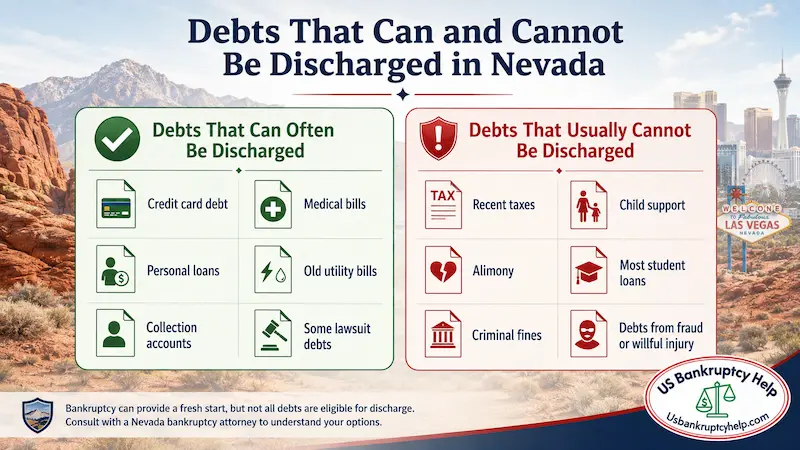
Whether a debt can be discharged depends on the type of debt, the chapter you file, whether the creditor objects, whether the debt is secured or unsecured, and whether special rules apply. Some debts are usually dischargeable, some are usually not, and some require a closer, case-by-case look.
| Debt Type | Usually Discharged? | Important Notes |
|---|---|---|
| Credit cards and medical bills | Often yes | Many unsecured debts, including credit cards, medical bills, personal loans, old utility bills, and collection accounts, may be discharged in Chapter 7 or Chapter 13. |
| Secured debts | Sometimes as personal liability | Bankruptcy may discharge your personal obligation on a mortgage, car loan, or other secured debt, but liens can survive. If you want to keep the collateral, you usually must keep paying or use Chapter 13 to handle arrears. |
| Older income taxes | Sometimes | Some older income tax debts may be dischargeable if specific timing, filing, assessment, and fraud rules are met. More recent taxes are often not discharged. |
| Domestic support obligations | Usually no | Child support, spousal support, alimony, and many related domestic support obligations are generally not dischargeable. |
| Student loans | Usually no, but sometimes | Student loans are not automatically discharged. A debtor typically must file a separate adversary proceeding and prove undue hardship or qualify under other applicable student-loan discharge rules. |
| Criminal fines and restitution | Usually no | Criminal fines, restitution, and many penalties tied to a criminal case are generally not discharged. |
| Debts from fraud | May Not Be Discharged | Debts involving fraud, false pretenses, false financial statements, or certain luxury purchases or cash advances shortly before filing can be challenged by a creditor. |
| Willful or malicious injury debts | May Not Be Discharged | Debts based on intentional injury to another person or to property may be excluded from discharge, especially if a creditor files a timely objection. |
| Debts not listed in the bankruptcy papers | Depends | Leaving out a debt can create discharge problems, particularly if the creditor did not receive notice in time to protect its rights. |
Discharge does not always mean every problem is gone.
- A lien can survive even if your personal liability is discharged.
- Some debts are only decided after a creditor files an objection.
- Certain categories of debt are automatically excluded from discharge by federal law.
- Chapter 7 and Chapter 13 may treat some debts differently.
- Co-signers, joint debtors, and non-filing spouses may still be responsible.
- Recent spending, cash advances, fraud allegations, or injury claims can lead to disputes.
Student Loans and Bankruptcy in Nevada
Student loans are different from many other debts in bankruptcy. They are not automatically discharged just because you file chapter 7 or chapter 13 in Nevada. To discharge student loans, a borrower usually needs to show that repayment would create an undue hardship.
That analysis is highly fact-specific. It can depend on your income, expenses, household size, dependents, health, disability status, work capacity, student loan balance, repayment history, loan type, and whether your financial hardship is likely to continue.
Use the Student Loan Discharge Checker below to enter information about your student loans and your financial situation. The tool gives an educated screening estimate of whether your student loans may be dischargeable in bankruptcy.
This tool does not guarantee a court result and is not a substitute for legal advice. It can help you decide whether student-loan discharge is worth discussing with a qualified bankruptcy attorney before or during a Nevada bankruptcy case. You can also use the full standalone Student Loan Discharge Checker.
For many Nevada filers, the most common dischargeable debts are credit cards, medical bills, personal loans, older utility balances, and collection accounts. Debts that usually need closer review include taxes, student loans, domestic support, criminal obligations, secured debts, recent purchases, fraud claims, lawsuits, and injury-related debts.
Before filing, review each debt on its own. The question is not only whether a debt might be dischargeable. You also need to know whether it is secured, whether a lien will remain, whether a creditor might object, and whether Chapter 7 or Chapter 13 is more likely to give you the result you need.
Nevada Bankruptcy Trends
Bankruptcy filing trends can offer useful background about financial pressure in Nevada, but they are not a personal recommendation to file or to avoid filing. A statewide rise or drop in cases does not answer the key question: whether bankruptcy fits your income, property, debts, exemptions, timing, and long-term goals.
The United States Bankruptcy Court for the District of Nevada publishes official case-filing statistics for Nevada bankruptcy cases. These statistics show filings by chapter, including Chapter 7, Chapter 11, and Chapter 13, and also break out some information by the Las Vegas and Reno filing offices.
How to use Nevada bankruptcy filing trends:
- Treat trends as background information about overall filing activity in Nevada.
- Do not assume that more filings mean bankruptcy is automatically right for your situation.
- Do not assume that fewer filings mean bankruptcy is unnecessary or off the table.
- Keep the focus on your debts, income, property, exemptions, collection pressure, and chapter choice.
For an individual Nevada filer, the better question is not whether statewide bankruptcy filings are going up or down. The better question is whether Chapter 7 or Chapter 13 would actually address the problem you are facing, such as credit card debt, medical bills, wage garnishment, foreclosure, repossession, tax debt, or property-risk concerns.
You can review official filing statistics directly from the United States Bankruptcy Court for the District of Nevada annual case-filing statistics.
What This Means for You
Bankruptcy in Nevada is not just about having debt. The real question is what problem you need to solve and which chapter is most likely to solve it without adding unnecessary risk.
Chapter 7 can be a good fit when unsecured debt is the main issue, for example, credit cards, medical bills, personal loans, old utility balances, or collection accounts, and the income, means test, property, and exemption rules all work in your favor. Chapter 7 is usually not designed to fix long‑term missed mortgage payments or significant, long‑running car arrears.
Chapter 13 may make more sense if you need time and structure to catch up on mortgage arrears, stop foreclosure, address vehicle arrears, prevent repossession, manage certain tax debts, handle domestic support issues, or protect property that may not be fully covered in Chapter 7.
Use this Nevada page as a decision starting point:
- If your main problem is credit cards, medical bills, or other unsecured debt, begin by looking at Chapter 7 eligibility and any property risk.
- If you are behind on a house, car, taxes, or support, Chapter 13 may deserve a closer look.
- If you own a home, vehicle, tools, business property, have money in bank accounts, expect a refund, or have a lawsuit or claim, review exemptions before you file.
- If foreclosure, repossession, garnishment, or a lawsuit is active, timing may matter just as much as chapter choice.
- If you recently transferred property, repaid family, or filed bankruptcy before, get advice before submitting any paperwork.
For property‑risk questions, the next step is usually to review Nevada exemptions. These rules can affect whether home equity, vehicle equity, bank funds, tax refunds, wages, benefits, lawsuits, tools, and personal property appear protected in a bankruptcy case.
If you are most worried about keeping property, see our Nevada bankruptcy exemptions guide. If you are more focused on choosing between Chapter 7 and Chapter 13, start with the problem you need bankruptcy to solve: eliminating unsecured debt, stopping collection pressure, catching up on secured debt, protecting property, or reorganizing what you owe over time.
The safer way to decide is to look closely at your actual situation: income, household size, assets, equity, exemptions, secured and priority debts, recent transactions, collection deadlines, and long‑term goals. Bankruptcy can be a powerful tool, but it works best when it is matched to the specific problem you are trying to fix.
Nevada Bankruptcy FAQs
Should I file chapter 7 or chapter 13 bankruptcy in Nevada?
It depends on the problem you need to solve. Chapter 7 may be a better fit when the main issue is unsecured debt, such as credit cards, medical bills, personal loans, or collection accounts, and the income, means test, property, and exemption issues work. Chapter 13 may be a better fit if you need time to catch up on mortgage arrears, stop foreclosure, deal with car arrears, prevent repossession, manage certain taxes or support issues, or protect property that may not be fully protected in chapter 7.
How do I know if I qualify for chapter 7 bankruptcy in Nevada?
Chapter 7 eligibility usually starts with your household income, household size, and the means test. If your income is below the Nevada median income for your household size, chapter 7 may be easier to qualify for. If your income is above the median, you may still qualify after allowed deductions, but the analysis becomes more detailed. You also need to review property, exemptions, prior filings, recent transfers, and whether chapter 7 actually solves your debt problem.
What are the chapter 7 bankruptcy income limits in Nevada?
The “income limits” for chapter 7 usually refer to the Nevada median income numbers used in the bankruptcy means test. These numbers depend on household size and filing date, and they can change over time. Being over the median income does not automatically mean you cannot file chapter 7, but it usually means the full means test calculation needs to be reviewed.
What property can I protect with Nevada bankruptcy exemptions?
Nevada bankruptcy exemptions may protect certain property, including home equity, vehicle equity, personal property, wages, benefits, tools, and other assets, depending on the facts. Exemptions do not automatically protect everything you own. You need to identify the property, estimate its value, subtract liens or loans, and compare the remaining equity or value to the exemptions that apply.
Can I keep my house if I file bankruptcy in Nevada?
You may be able to keep your house, but the answer depends on home value, mortgage payoff, equity, exemptions, payment status, and the chapter filed. In chapter 7, the key issue is whether the home equity appears protected by exemptions. In chapter 13, you may be able to keep the home while catching up on mortgage arrears through a repayment plan, if the plan is feasible and meets bankruptcy requirements.
Can I keep my car if I file bankruptcy in Nevada?
You may be able to keep your car if the equity is protected and the loan is handled correctly. In chapter 7, vehicle equity should be compared to the Nevada vehicle exemption, and you usually need to stay current if you want to keep a financed vehicle. In chapter 13, missed vehicle payments may be addressed through a repayment plan, and some vehicle loans may receive different treatment depending on the loan balance, vehicle value, purchase date, and other rules.
Can bankruptcy stop wage garnishment in Nevada?
Filing bankruptcy usually stops many wage garnishments through the automatic stay. The stay can give immediate relief from ongoing collection, but it has limits. Some debts, such as domestic support obligations, may continue to receive special treatment. If a garnishment is already active, timing matters because amounts already taken may require separate review.
Can bankruptcy stop foreclosure in Nevada?
Bankruptcy may temporarily stop foreclosure through the automatic stay if the case is filed before the foreclosure sale is completed. Chapter 7 may create a temporary pause, but it usually does not provide a long-term way to catch up on mortgage arrears. Chapter 13 is often the chapter that needs closer review when the goal is to keep a home and cure missed mortgage payments over time.
Can bankruptcy stop repossession in Nevada?
Bankruptcy may temporarily stop vehicle repossession through the automatic stay if the case is filed before the repossession occurs. If you are behind on vehicle payments and need to keep the car, chapter 13 may provide a way to deal with the arrears through a repayment plan. Chapter 7 may pause repossession, but it usually does not create a long-term catch-up plan for missed car payments.
Where do I file bankruptcy in Nevada?
Nevada bankruptcy cases are filed in the United States Bankruptcy Court for the District of Nevada. Nevada has two bankruptcy court filing offices: Las Vegas and Reno. The correct office generally depends on the county where the debtor lives. Before filing, confirm the proper office, complete the required credit counseling course, gather documents, and make sure the petition and schedules are complete.
What debts can be discharged in Nevada bankruptcy?
Many unsecured debts, such as credit cards, medical bills, personal loans, old utility balances, and collection accounts, may be discharged. Other debts need closer review, including taxes, student loans, domestic support, criminal fines, restitution, fraud-related debts, injury-related debts, and secured debts. Bankruptcy discharge is mostly controlled by federal law, not Nevada state law.
How long does bankruptcy take in Nevada?
A typical chapter 7 case often moves faster than chapter 13, but the exact timeline depends on trustee review, document requests, the 341 meeting, debtor education, objections, property issues, and whether the case is complete and accurate. Chapter 13 usually lasts much longer because the debtor must propose, confirm, and complete a repayment plan before receiving a discharge.
Does my spouse have to file bankruptcy with me in Nevada?
A spouse does not always have to file bankruptcy just because the other spouse files. However, household income, community property issues, joint debts, shared assets, mortgage obligations, vehicle loans, and collection exposure may all need review. In some situations, filing alone may make sense. In others, a joint case may be more complete or efficient.
What should I do before filing bankruptcy in Nevada?
Before filing, review chapter 7 versus chapter 13, check the means test, compare your property to Nevada exemptions, gather income records, tax returns, bank statements, bills, mortgage and vehicle information, lawsuit documents, and proof of property values. You should also review recent transfers, payments to family, secured debts, priority debts, prior bankruptcy filings, and urgent collection activity before filing.
Related Nevada Bankruptcy Resources
Use these Nevada bankruptcy resources to go deeper on the specific issue you are trying to solve. The Nevada home page is the starting point, but chapter choice, exemptions, income, property risk, and repayment-plan questions often need more focused review.
Nevada Bankruptcy Resources
| Nevada Resource | Use This If You Need To Understand |
|---|---|
| Nevada chapter 7 bankruptcy | Whether chapter 7 may help Nevada filers with credit cards, medical bills, personal loans, collection accounts, garnishments, and unsecured debt. |
| Nevada chapter 13 bankruptcy | Whether chapter 13 may help Nevada filers with mortgage arrears, car arrears, foreclosure, repossession, taxes, support issues, or nonexempt property. |
| Nevada bankruptcy exemptions | Whether home equity, vehicle equity, bank accounts, wages, benefits, tax refunds, tools, lawsuits, and other property may be protected under Nevada exemption law. |
Bankruptcy Tools and National Guides
| Tool or Guide | Use This If You Need To Understand |
|---|---|
| Chapter 7 means test calculator | Whether your household income and expenses may create a chapter 7 means test issue. |
| Chapter 13 plan calculator | Whether a chapter 13 repayment plan may be realistic based on income, expenses, arrears, secured debts, priority debts, and property issues. |
| Chapter 7 vs. chapter 13 bankruptcy | The main differences between liquidation, repayment plans, discharge, property protection, secured debts, and timing. |
| Chapter 7 bankruptcy guide | A national overview of how chapter 7 works, what it can discharge, and what issues should be reviewed before filing. |
| Chapter 13 bankruptcy guide | A national overview of chapter 13 repayment plans, plan payments, secured debts, priority debts, and plan completion. |
| Bankruptcy means test guide | How the means test works, what income counts, why household size matters, and why being over the median income does not always end the analysis. |
Suggested next step:
- Start with the Nevada chapter 7 page if your main problem is unsecured debt.
- Start with the Nevada chapter 13 page if you are behind on a house, car, taxes, support, or other priority debt.
- Start with the Nevada exemptions page if your biggest concern is keeping property.
- Use the calculators as screening tools, not as a substitute for legal advice.
Explore Bankruptcy Help by State
Browse our state guides to learn exemptions, means test rules, costs, and local procedures. Use these links to jump between states and compare your options.
- Arizona
- California
- Colorado
- Florida
- Georgia
- Illinois
- Indiana
- Maryland
- Michigan
- Nevada
- New York
- North Carolina
- Ohio
- Oregon
- Pennsylvania
- Tennessee
- Texas
- Virginia
- Wisconsin