Can You File Bankruptcy on Student Loans? Check if You May Qualify

How This Article Was Reviewed▾
How We Review This Educational Content▾
Why You Can Trust This Page▾
Yes, you can file bankruptcy on student loans. Or more specifically, you can discharge student loans in bankruptcy. For many years, borrowers have assumed that student loans simply can't be discharged in bankruptcy. Fortunately, that isn't correct. Although student loans still require a borrower to prove undue hardship under 11 U.S.C. § 523(a)(8), the process for obtaining a discharge has become more structured and predictable.
The rules for discharging student loans are different from the rules for many other unsecured debts, like credit cards and medical bills. Also, the procedures for discharging student loans are different depending on whether or not they are private or federal. Below, we will explain what happens when you file bankruptcy with student loans, when student loan discharge may be possible, how the discharge process differs for private student loan and federal student loans, and how to use our free Student Loan Discharge Checker to review your situation.
How Can You Use Bankruptcy to Get Rid of Student Loans?
You can get rid of student loans in bankruptcy, but they are not automatically discharged. In most cases, to be able to discharge student loans, you must take an additional step in your bankruptcy case to show that repaying the debt would create an undue hardship.
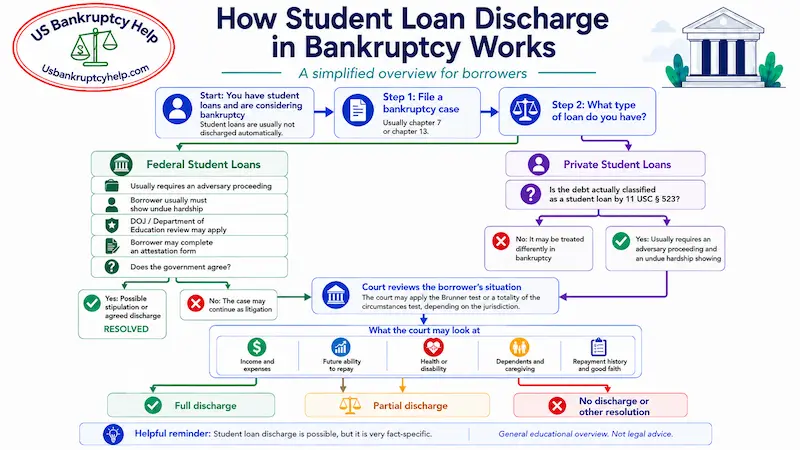
This extra step is usually filing an adversary proceeding within your bankruptcy case. An adversary proceeding is a lawsuit within a bankruptcy case. Whether discharging student loans is realistic in your case depends on your loan type, income, expenses, hardship factors, repayment history, and long-term financial outlook.
Who Can Qualify for a Student Loan Bankruptcy Discharge?
Qualifying for student loan discharge is not a one-size-fits-all situation. Eligibility depends on your unique set of circumstances and whether repaying the student loans would create an undue hardship.
A borrower may have a stronger case for student loan discharge when the facts show long-term financial hardship. Courts may consider factors such as:
- • Limited income
- • Necessary living expenses that leave little room for repayment
- • Health problems or disability issues
- • Dependents or caregiving responsibilities
- • A long history of financial hardship
- • Little realistic ability to repay the loans in the future
- • Past efforts to make payments, use income-driven repayment, request deferments or forbearances, or otherwise deal with the debt in good faith
Use the Student Loan Discharge Checker
It feels like most people think that student loans can never be discharged. We think that is one of the biggest bankruptcy myths. While discharging them may be challenging, it is possible and it is absolutely worth exploring.
That is why we created the Student Loan Discharge Checker. Simply enter your information into the form below, answer the questions as accurately as you can, and the tool will walk you through a detailed screening process.
At the end, you can save or print a PDF of your results for your records or bring it to a consultation with a bankruptcy attorney. Please keep in mind that the checker is not legal advice and does not guarantee a result, but it is a great place to start for understanding whether student loan discharge may be worth exploring.
What Does Undue Hardship Mean in Student Loan Bankruptcy?
If you have gone down the student loan bankruptcy rabbit hole, the term undue hardship probably keeps coming up. Undue hardship is the standard most borrowers have to meet to discharge student loans in bankruptcy.
The Bankruptcy Code uses the phrase “undue hardship,” but it does not give a detailed definition. Because of that, courts have developed different legal tests to decide when repayment creates enough hardship to justify a student loan discharge.
Most courts use the Brunner test, while some courts use a broader approach called the totality of the circumstances test. Both tests focus on the borrower’s unique financial circumstances, but they organize the analysis differently. Here is a basic comparison:
| Legal Standard | What It Means | Why It Matters |
|---|---|---|
| Brunner Test | The borrower usually must satisfy three separate requirements: minimal standard of living, persistence of hardship, and good faith. | If the borrower fails one requirement, the court may deny the student loan discharge. |
| Totality of the Circumstances Test | The court looks more broadly at the borrower’s past, present, and reasonably reliable future financial circumstances. | This approach may be less rigid, but the borrower still must show that repayment would create an undue hardship. |
Which Bankruptcy Courts Use the Brunner Test or Totality of the Circumstances?
Whether your local bankruptcy court uses the Brunner Test or the Totality of Circumstances test depends on the federal circuit your bankruptcy court is in. Most bankruptcy courts generally use the Brunner test.
Here is a chart below that shows the test that each circuit usually uses to test whether or not there is undue hardship required to discharge student loans in bankruptcy.
| Federal Circuit | States and Territories | Undue Hardship Test Generally Used |
|---|---|---|
| 1st Circuit | Maine, Massachusetts, New Hampshire, Rhode Island, Puerto Rico | Often totality of the circumstances in lower courts, but the First Circuit Court of Appeals has not definitively adopted one test. |
| 2nd Circuit | Connecticut, New York, Vermont | Brunner test |
| 3rd Circuit | Delaware, New Jersey, Pennsylvania, Virgin Islands | Brunner test |
| 4th Circuit | Maryland, North Carolina, South Carolina, Virginia, West Virginia | Brunner test |
| 5th Circuit | Louisiana, Mississippi, Texas | Brunner test |
| 6th Circuit | Kentucky, Michigan, Ohio, Tennessee | Brunner test |
| 7th Circuit | Illinois, Indiana, Wisconsin | Brunner test |
| 8th Circuit | Arkansas, Iowa, Minnesota, Missouri, Nebraska, North Dakota, South Dakota | Totality of the circumstances |
| 9th Circuit | Alaska, Arizona, California, Guam, Hawaii, Idaho, Montana, Nevada, Northern Mariana Islands, Oregon, Washington | Brunner test |
| 10th Circuit | Colorado, Kansas, New Mexico, Oklahoma, Utah, Wyoming | Brunner test |
| 11th Circuit | Alabama, Florida, Georgia | Brunner test |
| Note: Student loan dischargeability is governed by federal bankruptcy law, so the applicable test generally depends on the federal circuit, not state law. Local bankruptcy court decisions and later appellate rulings should be checked before filing an adversary proceeding. | ||
How Does the Brunner Test Work?
The Brunner test is a three-part test. In courts that use this standard, the borrower generally must satisfy all three parts to receive a student loan discharge.
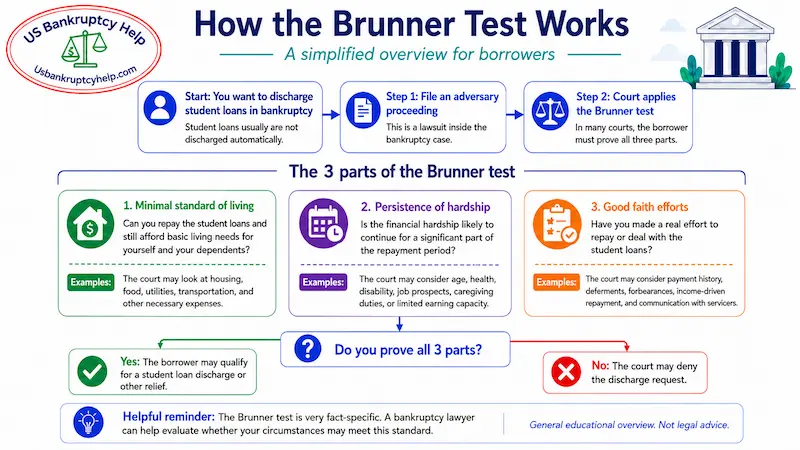
The Brunner test focuses on whether repaying the student loans would prevent the borrower from having a basic standard of living, whether the hardship is likely to continue, and whether the borrower has made a good faith effort to repay or address the loans.
1. Minimal Standard of Living
The borrower must show that they cannot maintain a minimal standard of living for themselves and their dependents if required to repay the student loans.
2. Persistence of Hardship
The borrower must show that their financial hardship is likely to continue for a significant portion of the repayment period. This often involves facts such as age, health, disability, job prospects, caregiving responsibilities, or limited earning capacity.
3. Good Faith Efforts
The borrower must show that they made good faith efforts to repay or otherwise address the student loans. Courts may look at payment history, deferments, forbearances, income-driven repayment, loan rehabilitation, consolidation, and communication with loan servicers.
The Brunner test factors are highly fact-specific. You can owe the same amount in student loans as someone else but have very different results. It all depends on income, expenses, health, dependents, repayment history, and realistic future earning ability.
How Does the Totality of Circumstances Test Work?
Under the totality of circumstances test, the bankruptcy court looks at the debtor's entire financial picture. Like the Brunner test, this is a borrower specific inquiry that requires documentation to support whether or not repaying the student loans would create an undue hardship.
The totality of the circumstances test is a little more flexible than the Brunner test because it doesn't strictly follow Brunner's three-part structure. Instead, the court considers the debtor's full financial picture.
The totality of the circumstances test may sound broad, so it is fair to wonder whether the test is different in every court that uses it. Generally, courts that use this approach look at the same core criteria: the debtor’s past, present, and reasonably reliable future income, the debtor’s reasonable and necessary living expenses, and any other facts that affect the debtor’s ability to repay the student loans. The exact weight given to each fact can vary from court to court.
| What the Court Looks At | What It Means | Examples |
|---|---|---|
| Past, present, and reasonably reliable future income | The court looks at whether the borrower has the ability to pay the student loans while still having the ability to pay for basic living expenses. | The court may look at the borrower's work history, current wages, age, health, job skills, career prospects, disability, caregiving duties to see if they can realistically pay. |
| Reasonable and necessary living expenses | The court reviews whether the borrower’s expenses are basic and necessary. | Are rent or mortgage, utilities, food, transportation, medical costs, insurance, childcare, taxes, and other ordinary household expenses reasonable? |
| Ability to maintain a minimal standard of living | The court asks if the borrower can repay the student loans while maintaining a basic, reasonable standard of living. | If the borrower makes the student loan payments, will they still be able to afford basic living expenses? |
| Other relevant facts and circumstances | The court can consider other facts that help explain the borrower’s financial situation and ability, or inability, to repay. | Dependents, family responsibilities, medical issues, disability, divorce, unemployment, retirement age, failed repayment efforts, or other unusual hardships. |
| Realistic repayment options | The court may consider whether repayment plans actually make sense for the borrower, instead of assuming a plan solves the problem. | Income-driven repayment availability, monthly payment amount, tax or forgiveness consequences, loan balance growth, and whether the plan would still leave the borrower unable to meet basic needs. |
| Overall fairness and financial reality | The court looks at the whole picture, not just one fact. The question is whether requiring repayment would be unfairly harsh based on the borrower’s real financial circumstances. | A borrower with low income, serious health issues, limited future earning ability, and necessary expenses may have a stronger undue hardship argument than someone whose hardship appears temporary. |
| The totality-of-the-circumstances test is flexible. No single fact automatically wins or loses the case. The bankruptcy court reviews the borrower’s entire financial situation to decide whether repaying the student loans would create an undue hardship. | ||
How Do You Ask the Court to Discharge Student Loans?
Earlier we mentioned that you had to file an adversary proceeding to ask the court to discharge student loans. As we touched on above, an adversary proceeding is technically a lawsuit filed within your bankruptcy case. Think of an adversary proceeding as a case within the bankruptcy case. The main bankruptcy case deals with your overall debts, assets, income, and discharge. The adversary proceeding focuses on one specific question: should your student loans be discharged?
Going through a student loan adversary proceeding can be slightly different depending on the court, the loan type, and the facts of the case, but the basic steps usually look like this:
| Step | What Usually Happens | Why It Matters |
|---|---|---|
| Student loans listed | The student loans are listed in the borrower's bankruptcy petition. | Listing the student loans gives notice to creditors and shows that the loans are part of the borrower’s overall financial picture. |
| File an adversary proceeding | The borrower files a separate lawsuit within the bankruptcy case asking the court to discharge the student loan(s). | This step requires notice to the student loan creditors so they may respond and participate in the process, and is the formal step needed to start the process. |
| Explain the hardship | The borrower explains why repayment of the loans is not realistic based on their financial situation. | The court reviews these facts to decide whether repayment would create an undue hardship. |
| Provide documents | The borrower may provide documents like pay stubs, tax returns, bills, medical records, disability records, loan statements, and repayment history to support their claim of hardship. | Documents help the court understand the borrower's financial situation and evaluate the undue hardship claim. |
| Wait for a response | The student loan creditors or government agency may respond to the borrower's claim. They may dispute the claim, ask for more information, or negotiate a settlement. | Creditor or government responses can affect the process and may lead to further negotiations or a court hearing. |
| Get a result | The results can be a full discharge, partial discharge, changed repayment terms, settlement, or denial of discharge. | Student loan discharge is fact-specific, so the outcome depends on the evidence and the legal standard used by the court. |
Federal Student Loans vs. Private Student Loans in Bankruptcy
Is your student loan a private loan or a federal loan? This distinction matters. Federal student loans usually require the borrower to show undue hardship. Private student loans may also require an undue hardship showing, but some private education-related loans may not be protected by section 523 of the Bankruptcy Code. If the loan does not fall within the Bankruptcy Code’s student loan exception, the borrower may have a different bankruptcy argument than undue hardship.
Federal student loans are loans made by the federal government or backed by the federal government. Examples of federal student loans include Direct Loans, some FFEL loans, Perkins Loans, and Parent PLUS Loans. On the other hand, private student loans are usually made by banks, credit unions, or other private companies.
| Loan Type | Common Examples | Bankruptcy Issue |
|---|---|---|
| Federal Student Loans | Direct Loans, Parent PLUS Loans, some FFEL loans, and Perkins Loans. | These usually require the borrower to show undue hardship, and the DOJ review process may apply in some cases. |
| Private Student Loans | Loans from banks, credit unions, online lenders, or private education lenders. | Many private student loans require undue hardship, but some private education-related debts may have different bankruptcy arguments. |
| Other Education-Related Debt | Some bar study loans, career training loans, school charges, or loans above the cost of attendance. | These debts may need closer review to determine whether they are treated like protected student loans in bankruptcy. |
Private Loan Warning: Not every private education-related loan is treated the same in bankruptcy. Some private loans may not qualify for the special protection given to certain student loans. Before assuming that an adversary proceeding and undue hardship analysis are required, it may be worth reviewing whether the loan is actually the type of debt that survives a normal bankruptcy discharge.
How the DOJ Reviews Federal Student Loan Discharge Requests
Adversary proceedings for federal student loans are a little different now than they were in years past. If you have federal student loans the Department of Justice (DOJ) may review your request in a more standardized process created with the Department of Education.
This review is used to evaluate whether your facts show undue hardship. Instead of forcing every case into a long and expensive process, the process is designed to collect and review a borrower’s financial information in a more organized way, which may reduce some of the burden on borrowers.
| What the DOJ May Review | Why It Matters |
|---|---|
| Income and expenses | These facts help show whether the borrower can maintain a basic standard of living while repaying the loans. |
| Assets | Assets may help show whether the borrower has resources available to repay the debt. |
| Repayment history | The government may review payment efforts, deferments, forbearances, income-driven repayment, or other attempts to manage the loans. |
| Hardship facts | Facts such as disability, medical issues, caregiving responsibilities, age, or limited earning ability may help explain why repayment is not realistic. |
| Future ability to repay | The review may consider whether the borrower’s financial hardship is temporary or likely to continue. |
Borrowers may be asked to complete an attestation form with this type of information. After reviewing the case, the government can agree that undue hardship exists, ask for more information, negotiate a resolution, or continue opposing your discharge.
If you have federal student loans, review the Department of Justice’s student loan bankruptcy guidance and attestation materials or speak with a bankruptcy lawyer to better understand how the process may apply.
Can Chapter 7 or Chapter 13 Discharge Student Loans?
A student loan discharge may be available in either chapter 7 or chapter 13, but the borrower usually still has to file an adversary proceeding and prove undue hardship. The choice between the two is more of an overall strategy decision based on your unique financial situation that does not change the basic student loan discharge requirement.
If you want a deeper explanation of the bankruptcy chapters themselves, you can read our guides to chapter 7 bankruptcy, chapter 13 bankruptcy, and chapter 7 vs. chapter 13 bankruptcy.
What Information Should You Gather Before Asking About Student Loan Discharge?
Since discharging student loans is very fact specific, it helps to gather information before using the checker or speaking with a bankruptcy attorney. You do not need to have everything perfectly organized, but having the basics in one place can make the discussion much more productive.
Helpful documents may include:
- • Recent student loan statements
- • A StudentAid.gov loan summary for federal student loans
- • Private student loan statements or promissory notes
- • Recent pay stubs or proof of income
- • Recent tax returns
- • A monthly budget showing necessary living expenses
- • Medical, disability, or caregiving documentation, if relevant
- • Records of payments, deferments, forbearances, income-driven repayment, rehabilitation, or consolidation
- • Collection letters, lawsuit papers, wage garnishment notices, or default notices
Frequently Asked Questions About Filing Bankruptcy on Student Loans
Can Student Loans Be Discharged in Bankruptcy?
Yes, student loans can be discharged in bankruptcy. The borrower usually must take the extra step of filing an adversary proceeding and showing that repayment would create an undue hardship on them.
Are Student Loans Automatically Discharged in Bankruptcy?
Usually, no. Student loans are commonly listed in the bankruptcy paperwork, but listing them does not normally discharge them. Most borrowers must file an adversary proceeding and show that repayment would create an undue hardship.
Do You Have to File an Adversary Proceeding to Discharge Student Loans in Bankruptcy?
In most cases, yes. An adversary proceeding is the separate lawsuit inside the bankruptcy case where the borrower asks the court to decide whether the student loans should be discharged.
Can Private Student Loans Be Discharged in Bankruptcy?
Private student loans can be discharged in bankruptcy. Some private student loans may require an undue hardship showing, while some private education-related debts may not qualify for special student loan protection at all.
Can Bankruptcy Stop Student Loan Collections?
Filing bankruptcy may temporarily stop some student loan collection activity through the automatic stay. Whether collections remain stopped depends on the type of loan, the bankruptcy chapter, and whether the student loans are ultimately discharged.
Student Loan Discharge Is Not Impossible
We hope we have shed some light on the myth that student loans are impossible to discharge in bankruptcy. Just remember that while it is possible, the facts matter.
If you are feeling overwhelmed by student loans, a good first step is to get organized. Use the Student Loan Discharge Checker above if you think it will help you. Feel free to save or print your results, and use that information as a starting point for a conversation with a bankruptcy attorney.
Explore Bankruptcy Help by State
Browse our state guides to learn exemptions, means test rules, costs, and local procedures. Use these links to jump between states and compare your options.
- Arizona
- California
- Colorado
- Florida
- Georgia
- Illinois
- Indiana
- Maryland
- Michigan
- Nevada
- New York
- North Carolina
- Ohio
- Oregon
- Pennsylvania
- Tennessee
- Texas
- Virginia
- Wisconsin