
Washington Bankruptcy Exemptions 2026

How This Article Was Reviewed▾
How We Review This Educational Content▾
Why You Can Trust This Page▾
Washington bankruptcy exemptions are laws that protect, or exempt, your property when you file bankruptcy. Washington is not an opt-out state, and you can choose to use Washington bankruptcy exemptions or federal bankruptcy exemptions, not both.
Whether to use Washington bankruptcy exemptions or the federal bankruptcy exemptions is a choice that requires careful consideration, and there are benefits to using each system. For example, Washington exemptions may protect more vehicle equity, while you may be able to use more of the available wildcard exemption in the federal scheme to protect cash and other property. The bankruptcy court explains this election in its Washington bankruptcy exemption guidance.
How Bankruptcy Exemptions Affect What You Can Keep
Your equity is the value of your ownership interest in your property after you subtract loans or other valid liens. For example, if you had a car worth $22,000 with a $12,000 loan, and no other liens or encumbrances, you have $10,000 equity in that vehicle. Washington's exemption laws use this approach to define value. See RCW 6.15.010(2).
In Chapter 7, if your equity in property is not covered by an exemption or is over an exemption amount, a Chapter 7 trustee could potentially sell the property to pay creditors. If your property is not exempt or is over an exemption limit, it doesn't automatically mean the trustee will sell it. Your ownership interest, sale expenses, and likely benefit to the bankruptcy estate all affect the trustee's decision. The federal court explains the trustee's role in their Chapter 7 bankruptcy overview.
In Chapter 13, if you have property that is not exempt or exceeds exemption limits, the plan usually has to provide unsecured creditors the value they would receive if you had filed Chapter 7. This means that you keep your property and make up for the amount that is not exempt through Chapter 13 plan payments. See 11 U.S.C. § 1325(a)(4), (a)(6), and (b).
If you want a more detailed explanation of Chapter 7 and Chapter 13, see our Chapter 7 vs. Chapter 13 guide, which explains how these chapters differ. The Washington bankruptcy court's exemption page also distinguishes exempt equity from secured debt.
Can You Choose Washington or Federal Bankruptcy Exemptions?
As we stated in the introduction, Washington is not an opt-out state. If you are eligible to use Washington exemptions, you can choose to use those exemptions, or the federal bankruptcy exemptions that are available under section 522(d). You cannot use both.
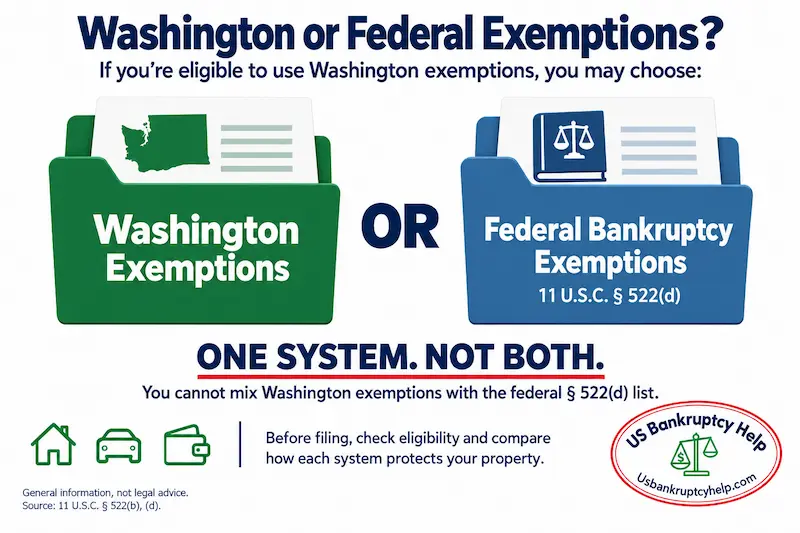
What determines whether you can use Washington bankruptcy exemptions? Federal bankruptcy law requires that you use the bankruptcy exemption scheme available under the laws of the state where you've been domiciled for the previous 730 days before filing your bankruptcy case. If you do not meet that test, Federal bankruptcy law then looks at the 180 days immediately before that period and the state where you were domiciled for the greater portion of those 180 days. See 11 U.S.C. § 522(b)(3).
How do you know if you should use Washington exemptions or federal exemptions? What exemption system you should use depends on your property, your unique financial situation, and your goals. Determine how both systems would protect your home equity, vehicles, bank balances, refunds, or other assets. "If you are considering filing bankruptcy, it's always a great idea to understand how both the Washington exemptions and the federal exemptions affect your case," said Washington bankruptcy attorney Erin M. Lane. "This is something you want to figure out well before you file. You shouldn't be filing first and guessing about exemptions later. I know it sounds simple enough, but you would be surprised at how many people do this," she continued.
If you're not sure which bankruptcy exemptions you can use, use our Bankruptcy Exemption Law Finder to work through your planned filing date and residence history. It helps identify the exemption system you may be eligible to use, which is the starting point for comparing the property protections below. It does not determine whether a particular asset is exempt. This is especially helpful if you're not sure whether or not you lived in Washington for 730 days.
Keep in mind that the tools linked in this guide are educational starting points and do not replace legal advice.
Washington's Homestead Exemption
Washington's homestead exemption can protect equity in a qualifying residence. It is a unique homestead exemption compared to other homestead exemptions because there isn't a single dollar amount that applies to the entire state. Instead, the amount of protection you receive depends on the county where your home is located. Below we compare the Washington homestead exemption with the federal homestead exemption.

| Exemption system | Equity protection | Key limitation |
|---|---|---|
| Washington | The greater of $125,000 or the county median single-family home sale price for the preceding calendar year. | Use your county's median sale price for the previous calendar year. For example, a 2027 filing, would use the county's 2026 annual figure. Federal restrictions can reduce the available protection. |
| Federal § 522(d)(1) | $31,575 in qualifying residence property. | Unused protection can increase the federal wildcard, subject to its separate limit. |
Sources: RCW 6.13.030; 11 U.S.C. § 522(d)(1); federal dollar adjustments.
To find your homestead amount available under Washington exemptions, look at your county's median sale price for the previous year. You have to use the annual county data that is published by the Washington Center for Real Estate Research, which is the source named in the statute, or its officially designated successor.
"When you research your county's median sale price, it's important to make sure you're using the annual figures for your county, rather than the statewide median," stated Lane.
Which Homes Qualify, and Do You Need a Declaration?
Real residential property or residential personal property on leased land, like a manufactured home, are covered by the exemption. The use of this property is important. An occupied principal residence usually gets automatic homestead protection under Washington law, but a declaration is required for some unoccupied property and personal-property homesteads. See RCW 6.13.010, RCW 6.13.040, and 11 U.S.C. § 522(l).
It's important to note that married owners and domestic partners can't separately claim the same premises to increase homestead protection above the statutory amount. This is different than the rules allowing spouses to combine certain personal-property exemptions. See RCW 6.13.020.
Federal Homestead Limits and Sale Proceeds
Under certain circumstances, federal law can limit your state homestead exemption. Section 522(p) puts a limit of $214,000 on specified interests acquired during the 1,215 days before filing for bankruptcy, with exceptions that include qualifying equity transferred from an earlier principal residence in the same state.
"Section 522 is applied across the board in every state, and this is something that people get wrong often", said Ben Wright, a veteran bankruptcy attorney. "Often people only check their local exemption scheme and ignore the federal limit. That can make a huge difference in the application of their homestead exemption, and whether or not their home equity is covered.", Wright said.
Selling a home before filing can raise a different issue. If you sell your home before filing bankruptcy to buy another home, the Washington exemption protects the sale proceeds up to your applicable homestead amount for one year after the funds are received. See RCW 6.13.070(3) and RCW 6.13.010(2)(c). "If you do sell a home before filing it's best to keep the sale and purchase records so the transaction can be evaluated by the bankruptcy trustee if necessary. You should also keep the proceeds from the home sale completely separate from any other funds," said Lane.
Washington's Motor Vehicle Exemption
Washington protects up to $15,000 of equity in your motor vehicle, while the federal exemption amount is $5,025.

| Washington | Federal § 522(d)(2) |
|---|---|
| $15,000 in a motor vehicle | $5,025 in one motor vehicle |
Sources: RCW 6.15.010(1)(d)(iv), (2); 11 U.S.C. § 522(d)(2); federal dollar adjustments.
Earlier we gave an example of someone having a car with a value of $22,000 with a $12,000 loan, and determined that they had $10,000 of equity in that vehicle. Under the Washington exemption, this amount would be exempt. Under the federal system, after applying the federal vehicle exemption stated in § 522(d)(2), $4,975 would not be protected by the federal vehicle exemption.
Keep in mind that the Washington vehicle exemption can only be applied to one car and a second car would need its own exemption analysis. Also, joint filers should check the spousal ownership rules before determining how much protection they can combine on their vehicles.
Washington's Wildcard Exemption: Cash, Bank Accounts, and Other Property
A wildcard lets you protect property that needs additional coverage or lacks an exemption. Washington's wildcard exemption protects up to $10,000 in other personal property. Personal earnings are excluded from this protection.
| Exemption system | Available amount | How it works |
|---|---|---|
| Washington | $10,000 in a bankruptcy case. | One shared allowance for qualifying other personal property. Personal earnings are excluded. |
| Federal § 522(d)(5) | $1,675 plus up to $15,800 of unused residence exemption; maximum $17,475. | Can cover any property, including cash or equity exceeding another federal exemption. |
Sources: RCW 6.15.010(1)(d)(ii); RCW 6.15.050(1); 11 U.S.C. § 522(d)(5); federal dollar adjustments.
Think of the Washington wild card exemption as a shared pool. For example, using $7,000 of the exemption for ordinary savings would leave $3,000 for other property. The maximum federal wildcard exemption is available only if enough of your residence exemption remains unused. If you use the full federal homestead exemption, for example, then you would only have the base federal wildcard amount of $1,675 available to use.
Household Goods, Clothing, Jewelry, and Personal Items
The Washington exemption scheme protects certain everyday possessions. Understanding these can help you protect the items you need and preserve your wildcard exemption for other property that might need its protection.
| Property | Washington protection | Federal § 522(d) comparison |
|---|---|---|
| Household goods, appliances, furniture, and home or yard equipment | $6,500 total, including provisions and fuel for maintenance. | Covered household and personal items share $16,850 total, with an $800 limit per item, under (d)(3). |
| Clothing; furs, jewelry, and personal ornaments | Wearing apparel is protected. Furs, jewelry, and personal ornaments have a combined $3,500 limit per individual. | Clothing uses the shared (d)(3) allowance. Jewelry has a separate $2,125 allowance under (d)(4). |
| Private libraries and electronic media; family pictures and keepsakes | $3,500 for private libraries, including qualifying electronic media. Family pictures and keepsakes are separately protected without a stated dollar ceiling. | Qualifying books and household items use the shared (d)(3) allowance; other items may need wildcard coverage. |
| A cellphone, personal computer, and printer | Specifically listed without a stated dollar ceiling. | No separate electronics allowance. Qualifying household items use (d)(3), with the shared total and item limits. |
| Professionally prescribed health aids | Protected for the debtor or a dependent without a stated dollar ceiling. | Prescribed health aids are separately protected under (d)(9), without a stated dollar ceiling. |
Sources: RCW 6.15.010(1)(a)–(d); 11 U.S.C. § 522(d)(3), (4), (9); federal dollar adjustments.
Washington's $3,500 limit on furs, jewelry, and personal ornaments doesn't apply to all your clothing. Also, exemptions in the category that are separately listed, like phone, computer, and printer shouldn't automatically consume the entire $6,500 household-goods allowance. An item's actual use is an important fact when deciding what category it falls under.
In the federal exemption system, the $16,850 allowance is shared across the property covered by section 522(d)(3). It's different from the Washington scheme because there isn't a separate amount for a category of items, except for jewelry, which has a separate allowance. For example, under the federal exemption scheme, a single $1,200 qualifying household item would exceed the $800 item limit.
What values should you use? Use reasonable current fair market values, supported by the item's condition and the sale price of similar items.
Can You Protect a Tax Refund in Washington Bankruptcy?
Washington doesn't have a dedicated bankruptcy exemption that protects tax refunds. However, there is some persuasive case law from 2021 that upheld the protection of a filer's earned income tax credit and additional child tax credit. That opinion is unpublished and shouldn't be considered binding precedent. This is discussed more below.
| Refund component | Washington approach | Federal § 522(d) approach |
|---|---|---|
| Ordinary refund from excess withholding | Some Washington filers use the Washington wildcard exemption to protect tax refunds. | The federal wildcard, if available, can protect the refund. There isn't a separate exemption for all tax refunds. |
| Earned income tax credit (EITC) and additional child tax credit (ACTC) | An unpublished bankruptcy appellate decision upheld protection of the debtor's 2020 EITC and ACTC under Washington public-assistance law. | Evaluate the particular credit under any applicable public-assistance provision and the available wildcard; do not assume every credit qualifies. |
Sources: RCW 6.15.010(1)(d)(ii); RCW 74.04.280; Ellis v. Moreno, No. WW-21-1124 (B.A.P. 9th Cir. Dec. 23, 2021); 11 U.S.C. § 522(d)(5), (10)(A).
In Ellis v. Moreno, the bankruptcy appellate panel treated the two refundable credits at issue as public assistance under Washington law. The disposition is unpublished and nonprecedential, with persuasive value. It does not establish that every part of every refund is exempt. Bring the full tax return and a breakdown of the expected refund so each component, the relevant tax year, and any remaining wildcard can be evaluated.
Retirement Accounts, Pensions, and Health Savings Accounts
Washington provides strong protection for retirement accounts like qualifying 401(k)s, pensions, and IRAs. It's important to know what type of retirement account you have and whether or not it is protected under Washington or federal bankruptcy exemptions.
| Account Type | Washington Protection | Federal Protection |
|---|---|---|
| Qualifying private employer plans, including 401(k)s and pensions | Protected without a stated dollar limit under Washington's retirement exemption. | Generally protected in full. The IRA dollar limit below does not apply to qualifying employer plans. |
| Your traditional and Roth IRAs | Qualifying accounts are protected under Washington's retirement exemption, which has no stated dollar limit. | The federal IRA exemption generally protects up to $1,711,975 combined per person, with additional protection for certain rollover funds. |
| Health savings accounts (HSAs) and medical savings accounts (MSAs) | Qualifying accounts are expressly protected without a stated dollar limit. | There is no dedicated HSA or MSA exemption in the federal exemption list. An available wildcard exemption may help protect the balance. |
Sources: RCW 6.15.020(3)–(5); 11 U.S.C. § 541(c)(2); 11 U.S.C. § 522(b)(3)(C), (d)(5), (d)(12), and (n). The federal IRA amount applies to cases filed on or after April 1, 2025, under the federal dollar adjustments.
How Washington Protects Wages in Bankruptcy
When you earned your pay matters if you're worried about keeping your paycheck. Wages earned before filing bankruptcy and wages earned after filing bankruptcy are treated differently.
For example, when you file Chapter 7, pay for work you do after you file belongs to you and isn't available to the trustee to pay creditors. But wages earned before filing could need an exemption, even if your employer pays you after you file. See 11 U.S.C. § 541(a)(6).
The table below shows how much of your pay is protected under Washington's wage-garnishment rules. Find the applicable debt category, then compare the two amounts in that row: the larger amount is protected, up to your total disposable earnings. These calculations are adjusted if you are paid on a different schedule.
| Type of debt | Amount protected |
|---|---|
| Consumer debt | 80% of disposable earnings, or 35 times Washington's minimum hourly wage, whichever protects more. |
| Private student loan debt | 85% of disposable earnings, or 50 times the highest minimum hourly wage under state or local law in Washington, whichever protects more. |
| Other debts covered by the general rule | 75% of disposable earnings, or 35 times the federal minimum hourly wage, whichever protects more. |
| Certain court-ordered spousal-maintenance debts | 50% of disposable earnings. Mandatory support and retirement assignment orders follow separate rules. |
Federal exemptions don't have a separate exemption for earned wages. You may be able to use the federal wildcard exemption for this, depending on how much of it you have available. See 11 U.S.C. § 522(d)(5).
Source: RCW 6.27.150; RCW 6.15.050(1).
Child Support, Social Security, and Other Benefits
Support payments and government benefits usually have their own protections in bankruptcy. Sometimes this protection comes from a state exemption, a federal exemption, or a federal non-bankruptcy law. The table below separates those protections into three columns: Washington exemptions, federal bankruptcy exemptions, and protections under other federal laws (non-bankruptcy laws).
With most assets you generally choose between Washington exemptions and the federal bankruptcy exemptions. But certain benefits, including Social Security and certain veterans benefits, have separate federal protections that can be applied. These are called federal non-bankruptcy protections because they come from laws outside the Bankruptcy Code.
| Payment | Washington Exemptions | Federal Bankruptcy Exemptions | Federal Non-Bankruptcy Law |
|---|---|---|---|
| Child support, alimony, and spousal support | Protects overdue, current, and future support paid or owed to you. You must be able to identify the money as support through payment records or other documentation. RCW 6.15.010(1)(d)(v). | Protects your right to receive support to the extent reasonably needed for you and your dependents. 11 U.S.C. § 522(d)(10)(D). | No general separate federal exemption listed here. Compare the Washington and federal bankruptcy protections. |
| Social Security | The separate federal protection applies even if you choose Washington exemptions. See the last column. | Protects your right to receive Social Security benefits. 11 U.S.C. § 522(d)(10)(A). | Generally protects benefits already paid and benefits still owed to you, including in bankruptcy. Applies regardless of your exemption choice, subject to federal exceptions. 42 U.S.C. § 407. |
| Veterans' benefits | Qualifying benefits have separate federal protection when you choose Washington exemptions. See the last column. | Protects your right to receive veterans' benefits. 11 U.S.C. § 522(d)(10)(B). | Generally protects qualifying VA benefits before and after payment. Exceptions include certain benefit overpayment claims and federal tax collection. 38 U.S.C. § 5301. |
| Washington unemployment benefits | Protects benefits owed to you. After payment, benefits must remain separate from other money to qualify for this state protection. Exceptions include certain support claims and debts for necessities provided during unemployment. RCW 50.40.020. | Protects your right to receive unemployment benefits. 11 U.S.C. § 522(d)(10)(A). | No general separate federal exemption listed here for Washington unemployment benefits. |
| Washington workers' compensation | Generally protects covered payments before and after they are issued. Exceptions include certain child-support claims. RCW 51.32.040. | May protect your right to receive payments that qualify as disability or illness benefits. The type of payment matters. 11 U.S.C. § 522(d)(10)(C). | No general separate federal exemption listed here for Washington workers' compensation. Federal workers' compensation programs have different rules. |
| Public assistance | Protects assistance payments covered by Washington's public-assistance law from creditor collection and bankruptcy proceedings. RCW 74.04.280. | Protects your right to receive a qualifying local public-assistance benefit. 11 U.S.C. § 522(d)(10)(A). | Depends on the assistance program. Identify the benefit before assuming a separate federal protection applies. |
The term “No general separate federal exemption listed” in the table doesn't mean the benefit is not protected. The Washington or federal bankruptcy exemption may cover it.
Washington's Tools of the Trade Exemption
If you rely on tools or equipment to earn a living, bankruptcy may allow you to keep them. Washington protects up to $15,000 in qualifying tools, instruments, materials, and supplies used in your trade.
| Exemption System | Amount Protected | Property Covered |
|---|---|---|
| Washington exemptions | Up to $15,000 per person. | Tools, instruments, materials, and supplies used to carry on your trade. |
| Federal exemptions | Up to $3,175 per person. | Tools, implements, and professional books used in your trade or a dependent's trade. |
Sources: RCW 6.15.010(1)(e); 11 U.S.C. § 522(d)(6). The federal amount applies to cases filed on or after April 1, 2025, under the federal dollar adjustments.
Depending on your work, qualifying property could include a mechanic's hand tools, a carpenter's saws, or a hairstylist's equipment. The connection to your work matters: owning tools for a hobby does not, by itself, make them tools of the trade.
The limit applies to the combined value you claim under this exemption. Use the equipment's current fair market value, taking its age, condition and comparable sales into account.
Personal Injury Claims and Settlement Proceeds
Washington's personal injury exemption has no stated dollar limit for a claim or payment involving your injury or the injury of someone you depend on financially. So if you are expecting a settlement or have a personal injury claim, under the right circumstances, you may be able to protect it. See the table below.
| Type of compensation | Washington Bankruptcy Exemptions | Federal Bankruptcy Exemptions |
|---|---|---|
| Personal injury claim or settlement money | No stated dollar limit for a claim or payment involving your injury or the injury of someone you depend on financially. Certain injury-related liens and reimbursement claims remain enforceable. | Up to $31,575 for qualifying bodily-injury compensation involving you or someone you depend on financially. This particular exemption does not cover pain and suffering or compensation for actual financial losses, such as medical bills or past lost wages. |
| Money replacing income you will lose in the future | No stated dollar limit under the bankruptcy-specific provision for compensation replacing your future earnings or those of someone you depend on, or previously depended on, financially. Statutory exceptions still apply. | Protects compensation replacing future earnings to the extent reasonably needed to support you and your dependents. There is no fixed dollar limit, but the amount you can protect depends on those support needs. |
Sources: RCW 6.15.010(1)(d)(vii)–(viii); 11 U.S.C. § 522(d)(11). The $31,575 federal limit applies to cases filed on or after April 1, 2025, under the federal dollar adjustments.
If you think you may have an injury claim it is required to be disclosed whether or not you've filed a lawsuit. If you have an attorney, it is important to tell them about the claim and give them any relevant documentation necessary like claim records, settlement offers, and notices from anyone seeking repayment. See 11 U.S.C. § 541(a)(1).
Life Insurance and Annuities
If you have life insurance or an annuity it's important to identify what exactly you need to protect. Are you trying to protect the policy itself, money you can withdraw from it, a future payment like a death benefit, or regular income? Different exemption rules apply to each.
- Cash surrender value is the amount a policy is worth if it is cancelled. Term life insurance generally doesn't have a cash surrender value.
- A death benefit is the money paid to a beneficiary when the insured person dies. Being named as a beneficiary while that person is alive is different from being entitled to a payment after they die.
- An annuity is a contract that can provide payments now or in the future. Whether or not it is protected depends on whether it qualifies as retirement savings or is a separate investment.
| What you own or receive | Washington Exemptions | Federal Bankruptcy Exemptions |
|---|---|---|
| Cash value in an individual life insurance policy | No blanket protection for your own cash value. This law protects qualifying beneficiaries but expressly excludes interests claimed by the insured person or the person who obtained the insurance. Naming someone else as beneficiary does not automatically exempt cash you can withdraw. RCW 48.18.410(1), (3). | Up to $16,850 total in qualifying loan value, accumulated dividends, or interest. You must own the policy, and it must insure you or someone you depend on financially. Additional statutory conditions apply. § 522(d)(8). |
| A death benefit you receive as beneficiary of an individual policy | No stated dollar limit for a qualifying beneficiary. Protects proceeds against creditors of the insured and the person who obtained the policy, and against your debts existing when the money becomes available. Owner and insured exclusions still apply. RCW 48.18.410. | The amount reasonably needed for support. The deceased must have been someone you depended on financially when they died. Protection covers your support needs and those of your dependents. § 522(d)(11)(C). |
| Group life insurance, including qualifying coverage through work | The policy and its proceeds, with no stated dollar limit. Protection applies before and after payment. It excludes certain debtor-group insurance proceeds used to repay the debt the policy was issued to cover. RCW 48.18.420. | No separate group-life exemption. Apply the federal policy, cash-value, or death-benefit provision to the rights or money you actually own. § 522(d). |
| Rights in an annuity contract you paid for | Qualifying contract rights are protected. Creditors generally cannot force you to cash out or terminate the contract. Payments currently due are subject to the separate limit below. RCW 48.18.430(1). | No automatic protection for every annuity. Qualifying retirement funds may be exempt under § 522(d)(12). Other annuities must meet a separate exemption. |
| Payments currently due from your annuities | Up to $3,000 per month combined across covered contracts. Excess payments receive additional wage-garnishment protections and may be subject to a court order considering your family's reasonable needs. RCW 48.18.430(1)(b)–(c). | Qualifying payments needed for support. Certain payments tied to illness, disability, death, age, or length of service may qualify. Support needs and other statutory conditions limit protection. § 522(d)(10)(E). |
Federal provisions: 11 U.S.C. § 522(d)(7)–(8), (10)(E), (11)(C), and (12). The $16,850 amount applies to cases filed on or after April 1, 2025, under the federal dollar adjustments.
Education Savings Accounts
Washington bankruptcy exemptions can protect funds you contribute to a 529 plan or Coverdell education savings account, as long as those contributions were made more than two years before you file for bankruptcy. Washington also protects qualified prepaid tuition units purchased more than two years before filing for bankruptcy.
| Protection | What to check |
|---|---|
| Washington exemption | Qualifying tuition units purchased, and qualifying 529 or Coverdell contributions made, more than two years before filing are covered by RCW 6.15.010(1)(f). |
| Federal estate exclusions | Section 541(b)(5)–(6) provides separate, conditional exclusions for covered education funds. Beneficiary relationships, contribution timing, and applicable limits matter; these exclusions are not part of the § 522(d) election. |
Sources: RCW 6.15.010(1)(f); 11 U.S.C. § 541(b)(5)–(6).
How Marriage and Joint Ownership Can Change Exemption Analysis
In joint cases each spouse can usually claim personal-property exemptions and combine them for the same property or use them for different property. For example, in a joint case a couple's combined Washington bankruptcy wildcard could go up to $20,000 for certain property. This doesn't apply to the Washington homestead exemption. See RCW 6.15.010(3) and RCW 6.13.020.
Federal exemptions generally apply separately to each debtor in a joint case, subject to the election and ownership rules. But if only one spouse files, Federal estate rules can bring qualifying community-property interests into the case, including interests involving the nonfiling spouse. See 11 U.S.C. § 522(m) and 11 U.S.C. § 541(a)(2).
Example: Assume a married couple in Washington owns a car as community property, that both spouses have equal management rights of the car, and the car has $8,000 in equity. If only one spouse files bankruptcy, the entire community-property interest, including its $8,000 in equity, would enter the bankruptcy estate. The filing spouse can't simply state their one half interest as value. The filing spouse also can't claim two sets of federal exemptions just because they are married. If both spouses file jointly and choose federal exemptions, each can generally claim an exemption for their ownership interest. Filing alone therefore requires checking the protection available for the entire community-property interest included in the case.
Washington also restricts a spouse's use of personal-property exemptions in certain separate bankruptcies filed within six months when one spouse chooses federal exemptions. Title documents, community-property status, and both spouses' filing histories therefore belong in the analysis. See RCW 6.15.050(8).
What to Check Before Relying on a Washington Bankruptcy Exemption
Figuring out your exemptions situation should be done carefully. A thorough list of your assets is a great place to start. Also, be ready to research values, transfers, and prepare documentation about ownership interest. The list below is some of the items you may want to research and prepare:
- Your Residence History: where were you domiciled and how long did you live there? Include specific dates of any interstate moves.
- Ownership interest and property value: Gather deeds and vehicle titles. Get current property values, loan balances, and information about co-owners.
- Money sources: bank statements, pay stubs, benefit letters, and records tracing support or protected payments.
- Expected money: tax returns, tax refund breakdowns, unpaid wages, and potential legal claims.
- Account details: retirement plan documents, rollover records, insurance policies, and education-account contribution histories.
When you're in a place where you understand all of your assets and their value, compare the exemption systems that are available. Keep in mind that recent moves, purchases, transfers, or sales can affect your analysis. Washington's personal-property exemptions also have eligibility restrictions and exceptions, including a nonresident restriction and protection for valid security interests. See RCW 6.15.050.
USBankruptcyHelp.com provides educational information. This guide is not legal advice for a particular case. Exemption eligibility, available amounts, and filing decisions depend on the applicable law and your circumstances.