When debt feels out of control, bankruptcy chapter 7 colorado can be a powerful tool to reset your finances. Chapter 7 bankruptcy in Colorado allows many people to wipe out qualifying unsecured debts and get immediate relief from most collection activity.
Before you file, it’s important to understand how the process works and whether you qualify. Colorado residents must meet specific income and eligibility criteria, including passing the means test, to move forward under chapter 7.
The means test compares your household income to the Colorado median for a similar family size. It also looks at your allowed living expenses to see how much, if any, disposable income you have. These income limits are adjusted from time to time, so using current numbers is essential.
Filing chapter 7 bankruptcy in Colorado starts with submitting a petition and supporting forms to the bankruptcy court. Once your case is filed, a bankruptcy trustee is appointed to review your paperwork, evaluate your assets, and, if necessary, sell non-exempt property to pay creditors.
Colorado law provides exemption protections for many everyday assets, including homestead (home equity), vehicles, and essential personal property. Knowing how these exemptions work can make the difference between keeping key assets and losing them.
Chapter 7 bankruptcy can offer a real fresh start, but it is also a serious legal and financial decision. Understanding the benefits, risks, and long-term impact on your credit and assets is crucial before you decide whether this path is right for you.
In simple terms, bankruptcy chapter 7 colorado is a federal court process created under Chapter 7 of the U.S. Bankruptcy Code (11 U.S.C. §§ 701–784). The goal is to give honest but overwhelmed consumers a fresh start by allowing the bankruptcy court to enter a discharge of qualifying debts under 11 U.S.C. § 727.
In a typical chapter 7 case, you file a petition and detailed schedules with the Colorado bankruptcy court. A court-appointed trustee reviews your paperwork, looks for non-exempt assets, and, if necessary, sells those non-exempt assets to distribute funds to creditors. In many consumer cases, there are no non-exempt assets to sell, but the trustee review is always part of the process.
Not all debts are dischargeable in Chapter 7. Certain obligations, such as most student loans, domestic support obligations (like child support and alimony), some recent income taxes, and debts arising from fraud or intentional misconduct, may survive the discharge. Understanding which debts are wiped out and which are not is a key part of planning any Chapter 7 bankruptcy in Colorado.
Chapter 7 itself is governed by federal law, but Colorado law plays a major role in what happens to your property. Under 11 U.S.C. § 522, states can choose whether residents use federal exemptions or state exemptions. Colorado has opted out of the federal exemption scheme, so most filers must use Colorado’s exemption laws, including personal property exemptions found in Colo. Rev. Stat. §§ 13-54-101 et seq. and homestead protections in Colo. Rev. Stat. §§ 38-41-201 et seq.
These Colorado exemptions determine which assets you can protect and keep through the Chapter 7 process. The interaction between federal bankruptcy rules and Colorado exemption statutes is often where an experienced Colorado bankruptcy attorney adds the most value.
Here's what Chapter 7 generally involves:
This path can offer powerful relief, but it is also a serious legal and financial step that should be taken with full understanding of the rules and consequences.
When people ask how chapter 7 bankruptcy colorado works, they’re really asking what happens from the moment you decide to file until the court signs your discharge order. Chapter 7 Colorado cases follow a structured set of steps designed to gather your financial information, protect you with the automatic stay, and determine what happens to your debts and property.
The process starts with gathering detailed financial information: income, expenses, debts, assets, and recent financial transactions. These details are used to complete your bankruptcy petition, schedules, and related forms that will be filed with the United States Bankruptcy Court for the District of Colorado.
Once your chapter 7 Colorado case is filed, the automatic stay under 11 U.S.C. § 362 takes effect. This court order stops most collection actions against you, including wage garnishments, collection calls, and many types of lawsuits. For many people, this immediate pause in creditor pressure is one of the biggest benefits of filing.
After filing, a Chapter 7 trustee is appointed to oversee your case. The trustee reviews your paperwork, verifies your financial disclosures, and determines whether there are any non-exempt assets that could be sold for the benefit of creditors. In many consumer Chapter 7 cases in Colorado, everything you own is protected by Colorado bankruptcy exemptions, so there is nothing for the trustee to liquidate.
Below is a simplified summary of how the process typically unfolds:
Understanding these steps in advance makes it easier to plan, gather the right information, and work with your attorney to move through the Chapter 7 process in Colorado as smoothly as possible.
Before you dive into the details of the Colorado chapter 7 income limit and the means test, it helps to step back and ask a basic question: do you actually qualify for chapter 7 bankruptcy colorado? The Bankruptcy Code and U.S. Trustee Program set out eligibility rules that look at your income, the type of debt you have, and your recent financial history.
For most Colorado residents with primarily consumer debts, eligibility starts with the Colorado chapter 7 income limit and means test. If your household income is under the Colorado median for your family size, you generally clear the income screen for chapter 7. If you are over the median, you may still qualify by passing the full chapter 7 bankruptcy Colorado means test, which subtracts allowed expenses to see how much disposable income you have under 11 U.S.C. § 707(b).
The law also recognizes that not every case fits neatly into the consumer-means-test framework. In practice, Colorado filers may qualify for chapter 7 in several different ways based on income and the nature of their debts:
Once you understand how you fit into these income and means-test categories, it becomes much easier to interpret the Colorado chapter 7 income limit table and the “under the median” and “over the median” examples that follow.
Even if you qualify based on income and the Colorado chapter 7 means test, you must also satisfy several additional requirements before the court will grant a chapter 7 discharge. These rules are separate from Form 22 and apply in every Colorado case.
These additional requirements apply alongside the Colorado chapter 7 income limit and means test rules, and they are just as important for making sure your case ends with the discharge you are looking for.
The Colorado chapter 7 income limit and the Colorado chapter 7 means test work together to decide whether you qualify for Chapter 7 bankruptcy in Colorado. For many people, this starts with a simple comparison: is your household income below or above the Colorado median income for your family size?
Under 11 U.S.C. § 707(b), the means test is designed to screen out cases where someone with higher income could reasonably repay creditors over time. If your annualized current monthly income is below the Colorado median for your household size, you generally pass this part of the test and can move forward with Chapter 7 bankruptcy in Colorado without completing the full, second-stage means test calculation.
If your income is above the Colorado median, you do not automatically lose the ability to file Chapter 7. Instead, you move to the full chapter 7 bankruptcy Colorado means test, where you subtract allowed living expenses and certain secured and priority payments to see how much disposable income is left. That disposable income number is what determines whether your case is presumed abusive or whether Chapter 7 is still an option.
The median income figures used in the means test come from the U.S. Trustee Program and are updated regularly based on Census and IRS data. Below are example median income numbers for Colorado households for cases filed on or after November 1, 2025:
| Household Size | Annual Median Income (USD) |
|---|---|
| 1 | $85,685 |
| 2 | $106,690 |
| 3 | $127,495 |
| 4 | $149,566 |
| Median income figures are updated periodically by the U.S. Trustee Program. Always confirm the current numbers for your filing date. | |
To run the chapter 7 bankruptcy Colorado income limits and means test correctly, you will need two key sets of information:
If you fail the full Colorado chapter 7 means test, Chapter 7 is not always off the table forever—but the law may push you toward a Chapter 13 repayment plan instead. Because the numbers change over time and the rules are detailed, many people find it helpful to have a Colorado bankruptcy attorney double-check the means test before deciding how to proceed.
If you are wondering how to file bankruptcy chapter 7 in Colorado, it helps to think in terms of a clear checklist. The process is formal and paperwork-heavy, but it follows a predictable sequence: gather documents, complete required counseling and means test forms, file with the United States Bankruptcy Court for the District of Colorado, and work with the trustee through the 341 meeting until you receive a discharge. What follows is a broad overview, not a do-it-yourself guide. A Colorado bankruptcy attorney can help you apply these steps correctly to your specific situation.
The first step in bankruptcy chapter 7 colorado cases is gathering your financial records. You will need recent pay stubs, bank statements, tax returns, a list of all your debts, and a list of everything you own. Thorough documentation makes it easier to complete the official forms accurately and avoid delays or objections later in the case.
Before you can file, you must also complete a pre-filing credit counseling course from an agency approved by the U.S. Trustee Program. When you finish, you receive a certificate that must be filed with your Chapter 7 petition. At the same time, most Colorado filers will complete the Chapter 7 means test forms to show how they meet the Colorado chapter 7 income limit rules.
With your documents and counseling certificate in hand, you (or your attorney) prepare the bankruptcy petition, schedules, and related forms. These forms disclose your income, expenses, debts, assets, recent financial transactions, and any property you have transferred or given away. Accuracy and honesty are essential; mistakes or omissions can lead to delays or, in serious cases, denial of discharge.
Once everything is ready, your attorney files the Chapter 7 case with the Colorado bankruptcy court and pays the filing fee or requests a fee waiver or installment payments if you qualify. As soon as the case is filed, the automatic stay goes into effect, stopping most collection activity, wage garnishments, and pending lawsuits in your chapter 7 bankruptcy colorado case.
After filing, a Chapter 7 trustee is appointed to administer your case. The trustee reviews your paperwork and schedules a “341 meeting of creditors,” usually about a month after filing. You must attend this short meeting (often 10–15 minutes), answer questions under oath about your finances, and provide any additional documents the trustee requests.
Here is a streamlined list of the steps involved in filing Chapter 7 bankruptcy in Colorado:
Although this overview explains how to file bankruptcy chapter 7 in Colorado, it does not replace personalized legal advice. Chapter 7 forms are technical, the Colorado exemption rules are detailed, and mistakes can cost you money, property, or even your discharge. Deadlines, required notices, and local rules add another layer of complexity to every chapter 7 bankruptcy colorado case.
A knowledgeable Colorado bankruptcy attorney can help you decide whether Chapter 7 is the right fit, apply the Colorado exemptions correctly, complete the means test, and guide you from the initial strategy call through the discharge order. For most people, professional guidance more than pays for itself in peace of mind and in avoiding costly errors.
When people talk about chapter 7 bankruptcy colorado, they are really talking about how federal bankruptcy law and Colorado law work together in a single case. The U.S. Bankruptcy Code (Title 11 of the United States Code) sets the basic rules for Chapter 7 nationwide, including the automatic stay, the role of the trustee, the means test, and the discharge of qualifying debts. Colorado statutes and local rules then fill in important details about what happens to your property and how your case is administered in this state.
On the federal side, key provisions include the automatic stay under 11 U.S.C. § 362, which stops most collection activity the moment your case is filed, and the Chapter 7 discharge under 11 U.S.C. § 727, which wipes out many unsecured debts at the end of the case. Sections like 11 U.S.C. § 521 describe your duty to disclose assets, debts, and financial history, while 11 U.S.C. § 707(b) governs the Colorado chapter 7 means test and abuse analysis.
Colorado law then steps in to determine which assets you can keep through the process. Colorado is generally an “opt-out” state, which means most residents use Colorado’s own exemption statutes rather than the federal exemption list. These state-law protections cover things like equity in a home, a vehicle, and certain personal property, and they can make a tremendous difference in how a bankruptcy chapter 7 colorado case actually feels on the ground.
Because exemption rules are detailed and deserve their own treatment, this page only touches them at a high level. For a deeper dive into specific amounts and categories, see the dedicated Colorado bankruptcy exemptions page, which focuses entirely on how Colorado exemption laws protect your property in Chapter 7 and Chapter 13 cases.
One of the most common questions in any chapter 7 bankruptcy colorado case is simple: “What happens to my stuff?” Chapter 7 is sometimes described as a liquidation process, but in many Colorado consumer cases there is little or nothing for the trustee to sell because exemptions protect most or all of the filer’s everyday property.
When you file Chapter 7, all of your legal and equitable interests in property become part of the bankruptcy estate. The Chapter 7 trustee reviews your schedules to see which assets are fully protected by exemptions and whether anything is non-exempt. Exempt items stay with you; non-exempt items may be sold, but in a large number of Colorado cases there simply is no meaningful non-exempt property to liquidate.
On the debt side, Chapter 7 is designed to give you a fresh start by discharging many unsecured obligations. However, not every debt is treated the same. Some debts survive the discharge, and others can only be wiped out in limited circumstances. In broad strokes, here is what usually happens:
How these rules apply in real life depends heavily on your specific mix of assets and debts. A Colorado bankruptcy attorney can review your property, identify what is likely to be treated as exempt or non-exempt, and help you understand what your balance sheet might look like after a Chapter 7 discharge.
In every chapter 7 bankruptcy colorado case, a private trustee is appointed from the U.S. Trustee Program’s Chapter 7 panel. The trustee is not a judge; they are a court-appointed fiduciary who reviews your paperwork, conducts the 341 meeting of creditors, and decides whether there are any non-exempt assets worth administering for your creditors.
In the District of Colorado, there is a panel of multiple Chapter 7 trustees (typically around a dozen at any given time) who rotate through new cases. Your specific trustee’s name appears on the Notice of Bankruptcy Case (Official Form 309) you receive shortly after filing. You can also look up general trustee contact information through the U.S. Trustee Program’s Region 19 Chapter 7 page and the Private Trustee Locator.
The “341 meeting of creditors” is a required hearing in every Chapter 7 case. It is held outside the presence of the judge and is run by your trustee. In Colorado, these meetings have moved to a virtual format: the Bankruptcy Court has announced that, for Chapter 7, 12, and 13 cases, all Section 341 meetings are currently conducted by Zoom rather than in person, unless you receive a specific notice saying otherwise.
If the U.S. Trustee ever requires an in-person 341 meeting in your case, the location will be listed on your official notice. Historically, in-person Section 341 meetings for Colorado Chapter 7 cases have been held in locations such as:
Your specific 341 meeting date, time, Zoom link or phone instructions, and (if ever required) any in-person address will always appear on the notice that comes from the court and the U.S. Trustee. When in doubt, follow the information on that official notice rather than anything you read online.
The 341 meeting is usually scheduled about three to six weeks after your case is filed. For most people in a bankruptcy chapter 7 colorado case, the meeting itself is short—often 5 to 15 minutes—and much less intimidating than they expect. There is no judge present, and creditors rarely appear in routine consumer cases. The trustee’s main job is to verify your identity, confirm that your paperwork is accurate, and ask a few standard questions about your assets, debts, income, and recent financial history.
Typically, debtors must:
Your Colorado bankruptcy attorney will prepare you for the 341 meeting, make sure the trustee receives your documents on time, and be present with you during the hearing. For most honest debtors, the meeting is straightforward and marks an important milestone on the way to getting a Chapter 7 discharge.
A common question for Colorado residents is, “How much does it cost to file chapter 7 bankruptcy in Colorado?” The total cost of a chapter 7 bankruptcy colorado case usually includes the court filing fee, mandatory credit counseling and debtor education courses, the cost of obtaining credit reports and documents, and, for most people, attorney fees. Seeing all of these pieces in one place makes it easier to decide whether bankruptcy chapter 7 colorado is financially realistic for your situation.
The court filing fee for an individual chapter 7 case is currently $338 nationwide. That amount is set by federal law and is the same in the United States Bankruptcy Court for the District of Colorado as it is in other federal districts. The total combines the basic filing fee, an administrative fee, and a small trustee surcharge that helps fund the chapter 7 system.
Most filers pay the $338 at the time the case is filed. However, if you cannot afford to pay it all at once, the court may allow you to pay the filing fee in installments. In some lower-income cases, the court can even waive the filing fee entirely if you meet the income and hardship criteria. Your attorney can help you decide whether to request installments or a fee waiver and make sure the correct forms are filed.
In addition to the filing fee, every Colorado chapter 7 case requires two educational courses: a pre-filing credit counseling course and a post-filing debtor education course. These courses must be completed through providers approved by the U.S. Trustee Program, and each course typically costs somewhere in the range of about $15 to $50. Many providers offer reduced fees or waivers based on income.
Most people also incur small costs for things like a credit report (often a tri-merge report used to capture all creditors), document downloads, and copying or scanning financial records. These amounts are usually modest compared to the filing fee and attorney fees, but they are still worth factoring into your budget so you are not surprised during the process.
For many filers, the largest part of the overall chapter 7 bankruptcy colorado cost is the attorney fee. In a straightforward consumer chapter 7 case in Colorado, attorney fees are often quoted as a flat fee and can range from roughly the low four figures upward, depending on the attorney, the region of the state, and the complexity of your situation.
Several factors tend to push attorney fees higher, including a large number of creditors, complicated business or tax issues, borderline qualification under the Colorado chapter 7 means test, tight or contested exemptions, or a higher likelihood that the trustee will scrutinize assets closely. Business-related chapter 7 cases and cases involving significant real estate, multiple vehicles, or disputes with creditors usually cost more than a simple wage-earner case with a handful of credit card and medical debts.
Many Colorado bankruptcy attorneys offer payment plans for their fees, but there are strict rules about how and when those fees can be paid in a chapter 7 case. For example, you generally cannot charge attorney fees to a credit card that you plan to list in the bankruptcy. A good attorney will be upfront about what is included in the fee, what might cost extra, and how payment arrangements work.
Here is a high-level summary of common costs in a typical consumer chapter 7 case in Colorado:
Talking openly about costs during your initial consultation, and asking how complexity and payment options affect the fee, can make filing chapter 7 bankruptcy in Colorado much more manageable and less stressful.
A chapter 7 bankruptcy colorado filing will usually cause your credit score to drop, and the case can remain on your credit report for up to ten years from the filing date. That does not mean your credit is “ruined” for ten years, and it does not mean you will be unable to get any credit during that time. In practice, many people begin rebuilding their credit profile much sooner, especially if they take a proactive, structured approach after discharge.
Lenders look at more than just the fact that you filed bankruptcy. They also consider your current income, your debt-to-income ratio, how you have handled credit since the filing, and whether you have any recent late payments or collections. The discharge often leaves you with less debt than before, which can actually improve your ability to qualify for reasonable credit over time.
One of the biggest advantages of bankruptcy chapter 7 colorado is the clean slate it can give you for rebuilding. Instead of juggling old balances and collection calls, you can focus on establishing a new track record of on-time payments and responsible use of credit. Recovery is usually faster for people who are intentional and proactive after their case closes.
Many Colorado filers start rebuilding their credit by:
Over time, a pattern of on-time payments and low balances can matter more to many lenders than the older bankruptcy notation itself. For some people, their credit profile is stronger three to five years after Chapter 7 than it was in the years leading up to the filing.
Filing chapter 7 bankruptcy in Colorado is a serious decision, but it is also a chance to reset your finances and habits. Instead of viewing Chapter 7 as the end of the road, it can help to see it as the starting line for a more stable financial life: fewer debts, clearer priorities, and a deliberate plan for rebuilding.
A Colorado bankruptcy attorney or financial counselor can help you understand how Chapter 7 will affect your credit in your specific situation and suggest practical steps for rebuilding once the case is over. When you combine the legal fresh start of a discharge with proactive budgeting and careful use of new credit, recovery is often faster—and more sustainable—than many people expect when they first consider filing.
Chapter 7 bankruptcy in Colorado is not the only way to deal with debt, but many so-called “alternatives” are marketed aggressively without a full explanation of the risks. Before you sign a contract or send money to any company, it’s important to understand which options genuinely help and which ones too often delay the inevitable while your situation quietly gets worse.
Over more than 18 years of bankruptcy practice, I have met many people who tried for-profit “debt relief” or consolidation programs first. They were told to stop paying their creditors, paid thousands of dollars in fees, and were promised that everything would be handled. Instead, they watched late fees and interest pile up, collection calls continue, and lawsuits move forward. By the time they came in to talk about bankruptcy chapter 7 colorado or chapter 13, their position was harder—not easier.
There are also more structured alternatives that can legitimately fit some situations, especially when evaluated honestly alongside chapter 7 colorado and chapter 13 options. The most important of these is Chapter 13 itself, which is often the main alternative your attorney will compare side by side with Chapter 7.
No article can tell you, in the abstract, whether chapter 7 bankruptcy colorado, chapter 13, or a non-bankruptcy option is the best fit. What you can do is understand the common pitfalls of for-profit “debt relief” programs and make sure you compare them honestly with your legal options before you commit years of payments.
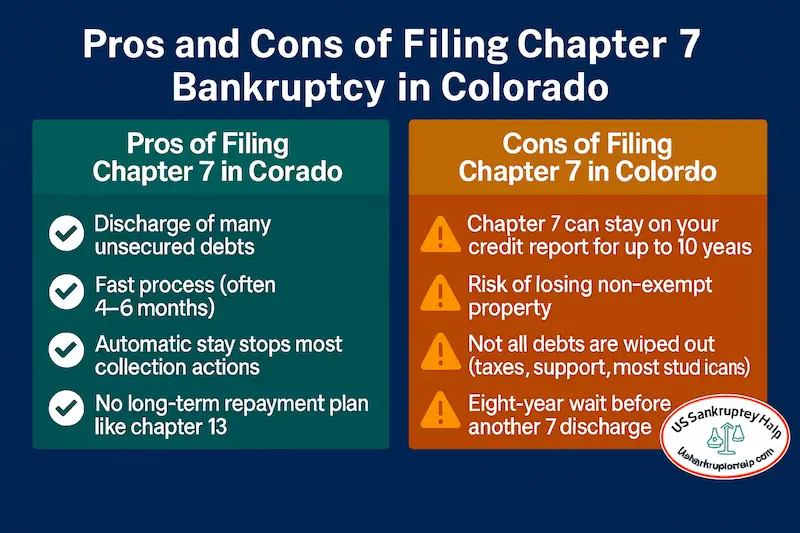
Deciding whether to file chapter 7 bankruptcy in Colorado is not just a legal question—it’s a big life decision. Chapter 7 can provide powerful relief for the right person in the right situation, but it also comes with tradeoffs. Understanding both sides can help you decide whether bankruptcy chapter 7 colorado is a tool you want to use.
The same facts that make Chapter 7 a lifeline for one person can make it a poor fit for someone else. If most of your debt is unsecured, your assets are well-protected by Colorado law, and you need a quick reset, chapter 7 may be a strong option. If you have significant non-exempt property, primarily non-dischargeable debts, or need time to catch up on a mortgage, a different approach—such as Chapter 13—might be better.
A brief consultation with a Colorado bankruptcy attorney can help you weigh these pros and cons using real numbers from your own budget, assets, and debts. That way, you are not just reading a generic list—you are making a clear-eyed decision about whether chapter 7 bankruptcy colorado is the right tool for your fresh start.
Most straightforward chapter 7 bankruptcy in Colorado cases take about four to six months from the date you file to the date you receive your discharge. The timeline can stretch out if the trustee needs more documents, if there are disputes about assets or exemptions, or if a creditor or the U.S. Trustee files an objection. In a typical consumer case with good preparation and prompt responses, you will attend your 341 meeting about a month after filing and then wait roughly another 60 days for the discharge order.
The rules on how often you can file chapter 7 bankruptcy colorado are set by federal law and apply nationwide. If you receive a Chapter 7 discharge, you generally must wait eight years from the date of the previous Chapter 7 filing before you can receive another Chapter 7 discharge. If you previously received a Chapter 13 discharge, the waiting period before a new Chapter 7 discharge is usually six years, with some exceptions when you paid a high percentage to unsecured creditors. You can technically file cases more often, but you may not be eligible for a discharge unless these timeframes have passed.
Colorado law allows you to protect some cash and money on deposit in a bankruptcy chapter 7 colorado case, but the amounts and categories can be very specific. The state’s exemption statutes protect certain types of funds—such as a portion of wages, certain benefits, or money traceable to exempt sources—up to particular dollar limits. Because these rules change over time and depend heavily on the source of the funds and how they are held, it is important to review your exact situation with a Colorado bankruptcy attorney or consult the current Colorado exemption statutes before filing. A small difference in how cash is categorized can mean the difference between keeping it and having a trustee demand turnover.
Many people who file chapter 7 bankruptcy in Colorado are able to keep their car. Whether you can keep yours depends on three main factors: how much equity you have in the vehicle, how the Colorado vehicle exemption applies to that equity, and whether you are current on your loan if the car is financed. If your equity is within the Colorado exemption limit and you are keeping up on payments (or the car is paid off), the trustee will usually treat the vehicle as exempt. If you have significant non-exempt equity, the trustee may ask you to pay the non-exempt value into the estate or, in rare cases, consider selling the vehicle. An attorney can help you run the numbers before you file.
Filing chapter 7 bankruptcy Colorado does not automatically mean you will lose your home. Colorado has a homestead exemption that protects a certain amount of equity in your primary residence. If your home equity is within that protected amount and you are current (or close to current) on your mortgage, many filers are able to keep their home in Chapter 7. Problems can arise when equity is far above the exemption limit or when mortgage payments are seriously behind. In those situations, Chapter 13 or a non-bankruptcy workout may be a better fit. Before filing, it is crucial to have a Colorado bankruptcy attorney review your home value, mortgage balances, and exemption options.
No. Married couples in Colorado are not required to file together. One spouse can file chapter 7 bankruptcy in Colorado without the other, or both spouses can file a joint case if that makes more sense. The right choice depends on how debts are titled, whether they are joint or separate, whose credit needs the most relief, and how Colorado’s exemption and property rules apply to your situation. In some households, a single-spouse filing is enough to deal with the problem debts while preserving the other spouse’s credit profile; in others, a joint filing is the cleanest way to wipe out shared obligations. A Colorado bankruptcy attorney can walk you through both scenarios before you decide.
By now, you have seen how chapter 7 bankruptcy in Colorado actually works: the Colorado chapter 7 income limit and means test, the role of the trustee and the 341 meeting, what happens to your assets and debts, and the real-world pros and cons. The next question is personal and practical: does bankruptcy chapter 7 colorado match your situation, your stress level, and your long-term goals, or is a different path a better fit?
For some people, chapter 7 is the first real chance in years to breathe—collection calls stop, unmanageable unsecured debts are wiped out, and they can focus on rebuilding instead of constantly treading water. For others, factors like non-exempt assets, primarily non-dischargeable debts, or the need to catch up on a mortgage suggest that chapter 13 or a non-bankruptcy option may be smarter. The key is to base your decision on accurate information, not sales pitches, fear, or half-truths from the internet.
You do not have to make this call alone. A conversation with a knowledgeable Colorado bankruptcy attorney can turn all of these rules, tables, and timelines into a clear picture of your case: how the Colorado means test applies to your income, how exemptions are likely to protect your home, car, and cash, and what your balance sheet may look like after a discharge. With that guidance, you can weigh chapter 7, chapter 13, and other approaches side by side and choose the path that gives you the best shot at a durable fresh start.
If your nights are already filled with worry about debts, lawsuits, or garnishments, simply learning your options is progress. Whether you ultimately file or not, taking the time to understand chapter 7 bankruptcy colorado and its alternatives is a step toward regaining control of your finances and your future.
Browse our state guides to learn exemptions, means test rules, costs, and local procedures. Use these links to jump between states and compare your options.