Understanding Florida Bankruptcy Exemptions: A Guide
A solid grasp of Florida bankruptcy exemptions is critical. Whether you're considering chapter 7 or chapter 13 bankruptcy. These exemptions protect your essential assets and must be understood.
Florida opts out of the federal bankruptcy exemption list. When Florida law applies under the domicile rules below, Florida residents generally use its exemptions instead of the list in 11 U.S.C. § 522(d). Other federal protections, including qualifying retirement funds and Social Security, can still apply. Fla. Stat. § 222.201 also adopts the benefit exemptions in § 522(d)(10) for cases filed on or after October 1, 1987. See Fla. Stat. § 222.20 and 11 U.S.C. § 522(b)(3).
Whether you're a Florida resident considering bankruptcy or a legal professional, this guide will help you explore how Florida's exemptions can achieve a fresh financial start, for you or your client.
What Are Bankruptcy Exemptions and Why Do They Matter?
Bankruptcy exemptions protect eligible property interests when you file. In chapter 7, a trustee can sell nonexempt property when a sale benefits the estate. In chapter 13, nonexempt value can increase the minimum your plan must pay unsecured creditors under 11 U.S.C. § 1325(a)(4). Exemptions do not by themselves remove mortgages, car loans, or other enforceable liens; see § 522(c).
Bankruptcy exemptions cover different types of assets, including:
- Your primary residence
- Personal property, like furniture and clothing
- Your Vehicle
- Certain retirement accounts
Understanding Florida's bankruptcy exemptions and their application can greatly affect the outcome of your bankruptcy case. While they may seem straightforward, many times their application is affected by case law and other administrative rules. Also, bankruptcy exemptions can change often. That is why it is highly recommended that anyone considering bankruptcy seek the advice of a Florida bankruptcy attorney.
Who Qualifies for Florida State Bankruptcy Exemptions?
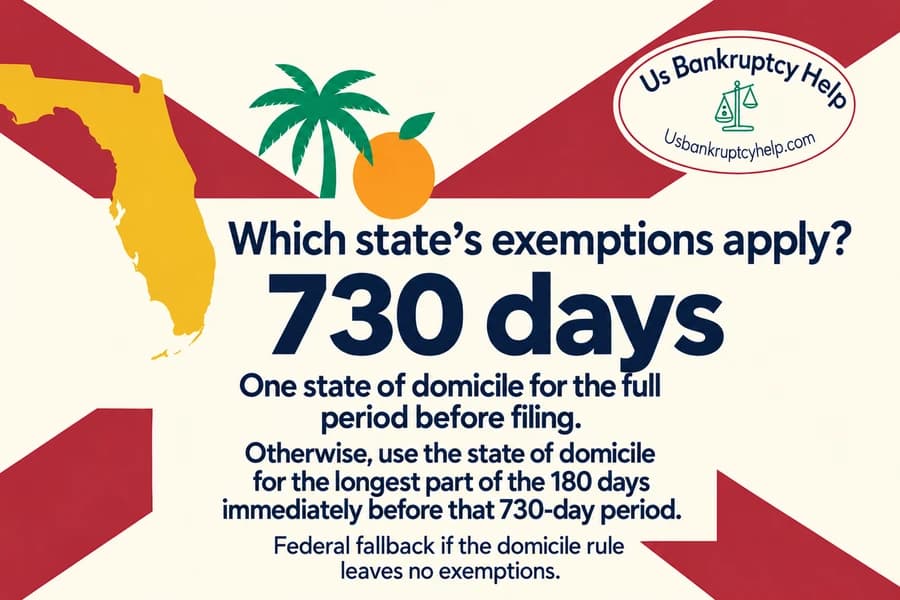
Under 11 U.S.C. § 522(b)(3)(A), Florida law generally applies if Florida was your domicile, meaning your permanent legal home, for the entire 730 days immediately before filing. If you were not domiciled in one state throughout that period, look to the 180 days immediately before those 730 days. The state where you were domiciled for a longer portion of that earlier period than in any other state controls, which may not be the state you most recently left. Check that state’s eligibility and out-of-state-property limits. If the domicile rule leaves you ineligible for any exemption, § 522(b)(3) allows the federal § 522(d) list. This exemption-law test is separate from where you may file your case (venue).
Timing Specific to Florida's Homestead Exemption
The 1,215-day rule is a federal cap, not a minimum period of home ownership. 11 U.S.C. § 522(p) can limit the amount of a covered home interest acquired during the 1,215 days before filing to $214,000 for cases filed on or after April 1, 2025. It excludes qualifying equity transferred from a previous principal residence acquired before that period into a current principal residence in the same state; a family farmer’s principal residence also has an exception. See the 2025 federal dollar adjustment notice. Recent purchases, transfers, and mortgage paydowns need individual review.
The Florida Homestead Exemption: Protecting Your Home
The Florida bankruptcy homestead exemption has no dollar cap under Florida’s Constitution for a qualifying home, but federal bankruptcy limits and the exceptions below can reduce that protection. See Florida Constitution, Article X, § 4.
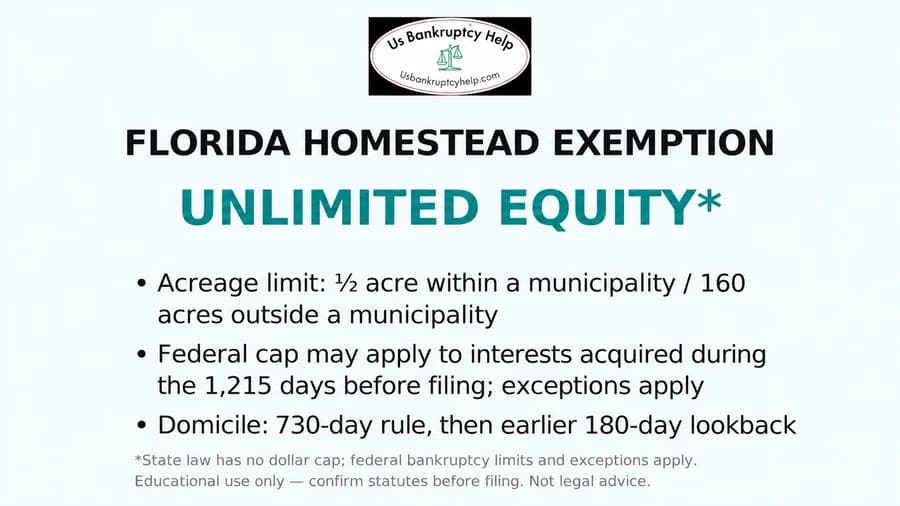
Timing and the infographic: The 1,215-day provision limits certain interests acquired before filing, with exceptions. The 730-day provision selects applicable state law and includes an earlier lookback; it is not a blanket waiting period for all protection.
Specific Requirements to Claim this Exemption
The homestead must qualify as your permanent Florida home and be owned by a natural person. Article X, § 4 protects up to ½ acre of contiguous land within a municipality, limited to the owner’s or family’s residence, or up to 160 contiguous acres outside a municipality. Later annexation does not reduce the protected acreage without the owner’s consent. Taxes and assessments, purchase obligations, and qualifying improvement, repair, or labor obligations are exceptions. A valid mortgage can still be enforced. Married spouses do not double these acreage limits.
If you sell the homestead, protection does not automatically cover all sale proceeds indefinitely. JBK Associates, Inc. v. Sill Bros., Inc. (Fla., April 28, 2016) requires a good-faith intent before and at the sale to reinvest in another homestead within a reasonable time. Keep the intended reinvestment proceeds separate from other funds and dedicated to that purpose; only the amount intended for reinvestment qualifies. There is no fixed six-month deadline under that rule.
Separate federal rules matter even for a long-owned home. § 522(o) can reduce the exemption for value attributable to nonexempt property converted into home equity within ten years with intent to hinder, delay, or defraud a creditor. § 522(q) imposes a separate $214,000 cap for specified misconduct or debts, with an exception for amounts reasonably necessary to support the debtor and dependents. This is a limit on a state-law claim, not an election of the federal exemption list.
Here are the main criteria for qualifying:
- Must be a primary residence.
- Applicable exemption law and federal limits must be checked, including recently acquired interests.
- Located within Florida.
Personal Property Exemptions in Florida
Florida protects some personal property in bankruptcy under both the state Constitution and state statutes. Understanding how these work—especially the “wildcard” for non-homestead filers—can significantly affect your outcome.
Constitutional personal property exemption: Up to $1,000 in total personal property value per debtor (e.g., furniture, electronics, clothing, appliances). Married joint filers can each claim $1,000 in interests they own; one spouse cannot exempt property owned only by the other. See Article X, § 4(a)(2).
Wildcard (non-homestead) exemption: If you do not claim or receive the benefits of the Florida homestead exemption, you may claim an additional $4,000 in personal property. This is commonly used to cover essentials that exceed the $1,000 constitutional cap. It does not apply to child-support or spousal-support debts. See Fla. Stat. § 222.25(4).
Note on vehicles: Florida provides a separate motor-vehicle exemption of $5,000 in a single vehicle, which is distinct from the personal-property amounts above.
Examples of personal property that can be covered by these limits include:
- Household furniture
- Clothing
- Appliances
Used together, Florida’s exemptions can help preserve a basic standard of living. If you neither claim nor receive constitutional homestead benefits, applying the $4,000 wildcard alongside the constitutional $1,000 can increase the personal property you keep. Little or no home equity, or simply omitting a homestead claim, does not by itself establish eligibility.
Example 1: Using Homestead (No Wildcard)
Hypothetical filer: Single, claims Florida homestead. Result: No wildcard available. These examples assume Florida exemptions apply, valid ownership interests, and no other applicable exemptions or special creditor claims.
- Household goods & electronics (fair-market used value): $1,600
- Clothing: $300
- Car equity: $6,200
Exemptions:
- $1,000 constitutional personal-property cap covers $1,000 of the $1,900 in household goods + clothing. Balance $900 is non-exempt.
- $5,000 motor-vehicle exemption covers $5,000 of car equity. Balance $1,200 is non-exempt.
Bottom line: $900 (household) + $1,200 (vehicle) = $2,100 non-exempt equity the trustee could require you to resolve (e.g., by buyback or turnover).
Example 2: No Homestead → Wildcard Available
Hypothetical filer: Single renter who neither claims nor receives constitutional homestead benefits. Result: Eligible for the extra $4,000 wildcard for personal property.
- Household goods & electronics: $2,300
- Clothing: $400
- Car equity: $4,800
Exemptions:
- $1,000 constitutional personal-property exemption.
- $4,000 wildcard (because no homestead) that can be applied to personal property.
- $5,000 motor-vehicle exemption (separate).
Apply them:
- Household + clothing total $2,700 → fully covered by $1,000 + part of the $4,000 wildcard → $0 non-exempt personal property.
- Car equity $4,800 → fully covered by the $5,000 vehicle exemption → $0 non-exempt vehicle equity.
Bottom line: With no homestead, stacking the $4,000 wildcard on top of the $1,000 constitutional amount often protects far more personal property.
Example 3: Married, Filing Jointly, No Homestead
Hypothetical filers: Married renters filing jointly, neither receiving constitutional homestead benefits. Each owns half the household goods and the car titled to that spouse. Each qualifies for separate exemptions in their own interests.
- Combined household goods (jointly owned): $3,200
- Two cars: Car A equity $6,200 (titled to Spouse A); Car B equity $3,000 (titled to Spouse B)
Exemptions per spouse:
- Personal property: $1,000 (constitutional) each + $4,000 wildcard each (because no homestead). Total PP protection = $10,000 across both spouses before using the vehicle exemptions.
- Motor vehicles: $5,000 per debtor, applied to the vehicle each one owns.
Apply them:
- Household goods $3,200 → each spouse’s $1,600 interest uses $1,000 constitutional protection and $600 of their wildcard.
- Car A $6,200 → Spouse A uses the $5,000 vehicle exemption and $1,200 of their remaining $3,400 wildcard.
- Car B $3,000 → fully covered by that spouse’s $5,000 vehicle exemption.
Bottom line: Joint filers can dramatically expand protection because exemptions are generally per debtor.
Important Notes
- The $5,000 limit applies to the separate vehicle exemption. Additional equity may be covered by available constitutional personal-property or eligible wildcard amounts; In re Mootosammy (Bankr. M.D. Fla. 2008) allowed cumulative exemptions in a vehicle under the then-current amounts. Today, keep track of each debtor’s ownership and unused allowances under § 222.25.
- Use fair-market value as of filing for the exemption analysis under § 522(a)(2), and subtract valid liens to determine equity. Do not assume a forced-sale price is appropriate; document condition, ownership, value, and loan balances.
The Wildcard Exemption: Flexible Protection
Florida’s “wildcard” exemption (Fla. Stat. § 222.25(4)) lets a debtor protect up to $4,000 of personal property if they do not claim or receive the benefits of the Florida homestead exemption. In a joint case, each eligible debtor can claim this amount in interests they own. Child-support and spousal-support debts are excluded.
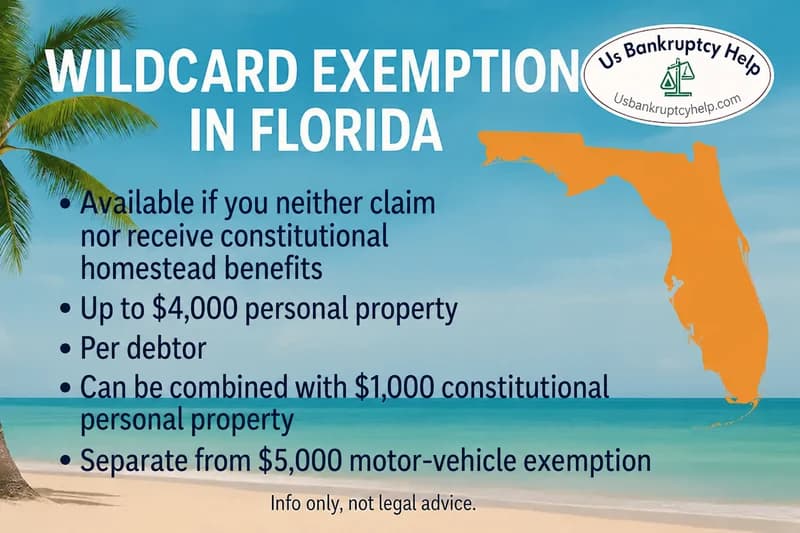
You can use the wildcard on almost any personal property (for example: cash, bank balances, tax refunds, household goods, jewelry, or vehicle equity) and combine it with other available personal-property exemptions. As the graphic notes, § 222.25(4) requires that you neither claim nor receive constitutional homestead benefits. In Osborne v. Dumoulin (Fla., February 3, 2011), a debtor who did not claim homestead and whose property remained available for trustee administration did not receive the constitutional benefit merely by owning the home. Keeping a home protected through a spouse or other circumstances calls for individual review.
Key benefits of the Wildcard Exemption include:
- Protecting extra personal property
- Offering strategic asset choices
- Enhancing overall financial security
Using this exemption wisely requires careful planning but maximizes your protection.
Motor Vehicle Exemption in Florida
Florida provides a $5,000 exemption in equity for a single motor vehicle per debtor under § 222.25(1). The increase from $1,000 took effect July 1, 2024, under Chapter 2024-110. Married joint filers can each claim up to $5,000 on a vehicle they own (typically the one titled in their name).
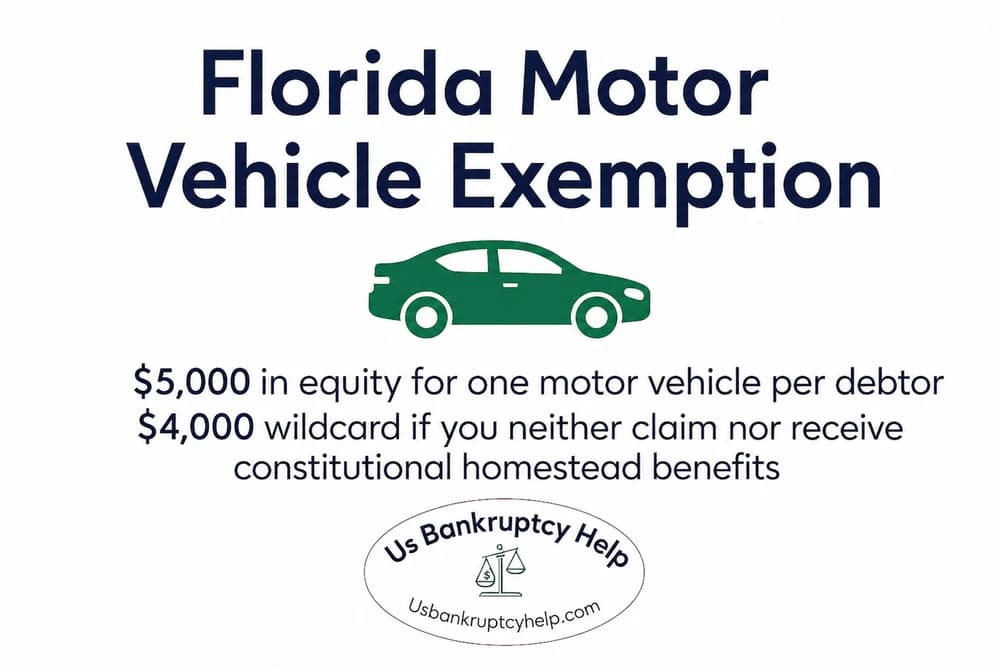
Here are the main details:
- Protects up to $5,000 of equity in one motor vehicle per debtor.
- Available whether or not you claim the Florida homestead exemption.
- If you neither claim nor receive constitutional homestead benefits, you may also use any available portion of Florida’s $4,000 wildcard to cover extra vehicle equity or other personal property, subject to its support-debt exception.
These exemptions protect your equity, not the lender’s lien. Keeping a financed vehicle also requires addressing the secured debt and applicable bankruptcy requirements; the exemption alone does not stop repossession after a default.
Wages, Retirement, and Financial Account Exemptions
In Florida, certain exemptions protect wages, retirement accounts, and financial assets from creditors in bankruptcy. Eligibility and the source of the funds determine the protection.
Under Fla. Stat. § 222.11, a head of family provides more than half the support of a child or other dependent. Disposable earnings of $750 a week or less are protected from attachment or garnishment. Above $750, protection continues unless waived in a writing meeting the statute’s requirements; federal garnishment limits still apply. Exempt earnings deposited in a financial institution remain protected for six months if traceable and properly identified. For a head of family, commingling alone does not defeat tracing. Non-head-of-family earnings have the more limited federal protection referenced in the statute. Bankruptcy adds a separate rule: § 522(e) makes an exemption waiver in favor of an unsecured creditor unenforceable as to property exemptible in the case. A wage exemption also does not automatically remove earnings from a chapter 13 plan’s income calculation.
Fla. Stat. § 222.21(2) protects qualifying tax-exempt retirement accounts, including eligible IRAs and 401(k)s. Qualification matters: an account’s label alone is insufficient. In re Yerian (11th Cir., June 26, 2019) explains that § 222.21(2)(a)(2) requires maintaining the IRA in accordance with its IRS-approved governing instrument. The debtor’s prohibited self-dealing violated that instrument and defeated the state exemption; the court did not treat compliance with the federal tax code as the sole state-law test. The statute also protects qualifying direct transfers or rollovers to inherited IRAs and qualifying IRA interests transferred incident to divorce, but has exceptions for qualified domestic relations orders and a surviving spouse’s elective-share order. Federal retirement protections under § 522(b)(3)(C) and certain exclusions from the estate under § 541(c)(2) are separate grounds for protection.
For the separate federal retirement-funds exemption, § 522(n) limits covered traditional and Roth IRA assets to an aggregate $1,711,975 for cases filed on or after April 1, 2025. SEP and SIMPLE IRAs and specified rollover amounts and earnings are excluded from that cap; a court may increase it in the interests of justice. This is not a universal cap on Florida’s separate retirement exemption. See the federal adjustment notice. Ordinary checking and savings accounts have no blanket exemption: identify a protected source of funds or another applicable exemption. § 222.22 protects specified qualifying tuition, education, health or medical savings, and hurricane savings arrangements; a savings label alone is not enough.
- Wages of the head of a family
- IRAs and 401(k) retirement accounts
- Traceable protected funds in financial accounts, where the applicable law allows
These exemptions are significant for maintaining financial dignity. They allow individuals to retain core assets necessary for future stability. Understanding these protections is critical for a successful bankruptcy process.
Insurance, Public Benefits, and Other Special Exemptions
Florida provides valuable exemptions for insurance policies and public benefits during bankruptcy. This reflects the state’s dedication to essential financial protections.
Fla. Stat. § 222.14 protects the cash surrender value of life insurance on Florida citizens or residents against creditors of the insured, and qualifying annuity proceeds against creditors of the annuity beneficiary, unless the policy or contract was made for that creditor’s benefit. Death benefits are different: § 222.13 generally protects designated-beneficiary proceeds from the insured’s creditors, but proceeds payable to the insured’s estate enter the estate. It does not create blanket protection from a beneficiary’s own creditors.
Social Security benefits are protected by 42 U.S.C. § 407, subject to specific federal exceptions such as qualifying support enforcement under § 659. Florida unemployment benefits have protection under § 443.051, with a support-intercept exception. Preserve records that identify benefit deposits. These laws protect different interests:
- Qualifying life-insurance cash values and death proceeds under different rules
- Qualifying annuity proceeds
- Social Security benefits
- Unemployment benefits
Fla. Stat. § 222.25(2)–(3) separately protects professionally prescribed health aids and a debtor’s federal earned income tax credit or refund, including traceable deposits. The EITC exemption excludes child-support and spousal-support debts; it does not cover every tax refund.
These protections have limits. Florida’s § 222.29 and § 222.30 address fraudulent transfers and conversions into otherwise exempt assets. Moving money into insurance or an annuity before filing does not guarantee protection.
Exemptions for Married Couples and Joint Property
Florida’s tenancy by the entirety can protect qualifying marital property against ordinary creditors of only one spouse, but not creditors owed jointly by both spouses. Joint ownership alone does not establish this protection. Ownership must qualify under the rules for the particular asset. For marital bank accounts, Fla. Stat. § 655.79 creates an entireties presumption unless otherwise specified in writing. In Loumpos v. Bank One (Fla., December 11, 2025), the Florida Supreme Court held that this presumption is not defeated because one spouse opened the account before the other was added. Do not apply a rigid same-time, same-title checklist to those bank accounts. Bankruptcy recognizes the protection only to the extent applicable nonbankruptcy law does, under 11 U.S.C. § 522(b)(3)(B).
Account documents and presumptions matter. In In re Del Amo (11th Cir., November 10, 2025), a generic joint-with-survivorship designation did not alone disclaim entireties ownership of the spouses’ bank account. Review the title, signature card, source of ownership, and joint debts before relying on this protection. Potential benefits include:
- Protection from ordinary creditors owed by only one spouse when entireties requirements are met
- Protection for qualifying marital assets, subject to joint debts and other applicable exceptions
Such exemptions illustrate Florida’s intent to shield marital property during financial turbulence.
The Process: How to Claim Florida Bankruptcy Exemptions
Claiming exemptions in Florida involves several key steps. First, you must list all your assets in detail on your bankruptcy schedules. Complete disclosure is necessary even for property you expect to exempt.
Next, select the appropriate exemptions:
- Identify eligible assets
- Match assets with relevant exemptions
- Complete required forms accurately
Determine the applicable exemption system using the domicile rule, then claim each exemption and its legal basis on Official Form 106C (Schedule C). Florida’s opt-out does not eliminate other federal protections. Under Bankruptcy Rule 4003, the usual objection period runs until 30 days after the creditors’ meeting concludes or an amendment is filed, whichever is later; extensions and special exceptions apply. A claim on the schedule is not a guarantee that an objection will fail.
When to Seek Legal Advice About Florida Exemptions in Bankruptcy
You should consult a Florida bankruptcy attorney if you are seriously considering filing for bankruptcy relief. Bankruptcy exemptions change often and are affected by case law. While they may seem "straight forward" on their face, they may not be as straight forward as you think.
Legal advice is especially vital if your situation involves significant home equity or joint property. An attorney can evaluate the title, debts, transfers, and timing that affect your protection.
Using Florida Bankruptcy Exemptions for a Fresh Start
Understanding and leveraging Florida's bankruptcy exemptions can ease financial distress. These exemptions provide a foundation for rebuilding after bankruptcy, helping preserve essential assets and enabling a fresh financial start.
Florida Bankruptcy Exemptions: Frequently Asked Questions
Who Can Use Florida’s Exemptions?
Florida residents whose exemption law is selected by 730 continuous days of Florida domicile generally use Florida exemptions, plus applicable federal protections and the § 522(d)(10) benefits adopted by Fla. Stat. § 222.201. If no single state covers those 730 days, use the state of domicile for the longest portion of the 180 days immediately before that 730-day period. If that rule leaves you ineligible for any exemption, § 522(b)(3) permits the federal § 522(d) exemptions.
How Does the Florida Homestead Exemption Work?
Florida’s Constitution sets no dollar cap on a qualifying homestead, with limits of ½ contiguous acre in a municipality or 160 contiguous acres outside. Bankruptcy law can limit covered interests acquired during the 1,215 days before filing to $214,000 for cases filed on or after April 1, 2025. Qualifying same-state replacement-home equity and family farmers have exceptions. The 1,215-day rule is not a minimum ownership requirement. Other federal limits and enforceable liens still matter.
What Is the Wildcard Exemption and When Can I Use It?
The wildcard protects up to $4,000 of personal property per eligible debtor who neither claims nor receives the benefits of Florida’s constitutional homestead exemption. It can be combined with the $1,000 constitutional personal-property exemption for cash, tax refunds, household goods, jewelry, or vehicle equity. Little or no home equity alone does not establish eligibility. The wildcard does not apply to child-support or spousal-support debts.
How Much Vehicle Equity Can I Protect?
Each debtor may exempt up to $5,000 of their interest in one motor vehicle under Florida law, effective July 1, 2024. An eligible debtor may apply unused personal-property or wildcard protection to additional vehicle equity. The wildcard requires that you neither claim nor receive constitutional homestead benefits. Equity is the vehicle’s fair-market value minus valid liens; exemptions do not eliminate the car loan.
Do Married Couples Get Separate Exemptions and How Is Joint Property Treated?
Each spouse in a joint case may claim exemptions in property interests they own, subject to each exemption’s eligibility rules. One spouse cannot use an allowance for property owned only by the other. Qualifying tenancy-by-the-entirety property can be protected from ordinary creditors of one spouse, but not joint creditors. Joint ownership alone does not establish that protection; title, account documents, and the nature of the debts matter.
Explore Bankruptcy Help by State
Browse our state guides to learn exemptions, means test rules, costs, and local procedures. Use these links to jump between states and compare your options.
- Arizona
- California
- Colorado
- Florida
- Georgia
- Illinois
- Indiana
- Maryland
- Michigan
- Nevada
- New York
- North Carolina
- Ohio
- Oregon
- Pennsylvania
- Tennessee
- Texas
- Virginia
- Wisconsin